



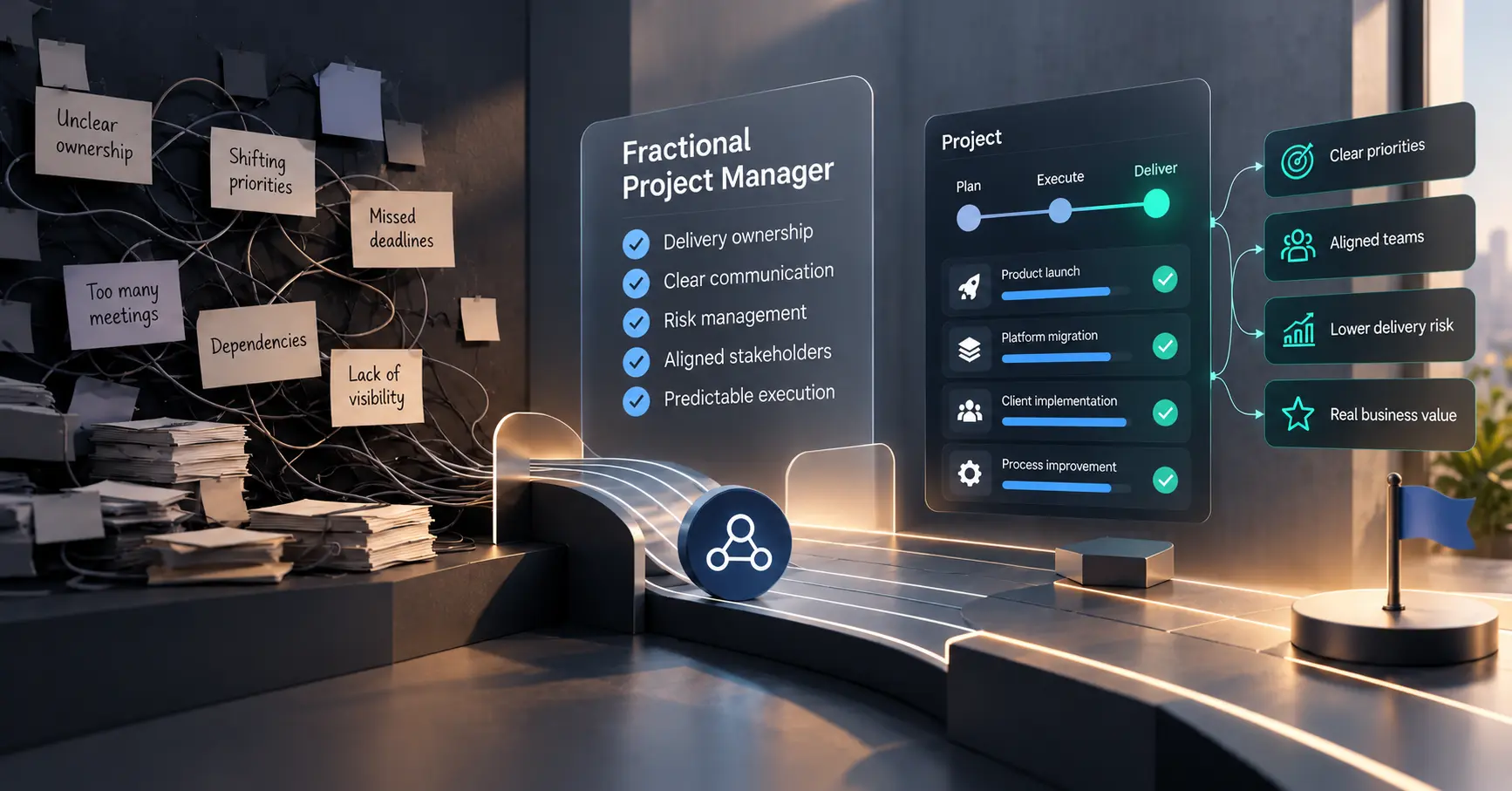
There is a stage in the growth of many technology companies when project management becomes necessary before a full-time project manager does.
A founder may still be coordinating product priorities. A CTO may be answering delivery questions between technical decisions. Engineers may be communicating directly with clients or other business functions because nobody else owns the complete delivery picture. Individual tasks continue to move, yet deadlines become harder to predict, dependencies are discovered late, priorities compete for the same resources, and leadership spends more time coordinating work than making decisions.
This is precisely the gap that fractional project management is designed to address.
A fractional project manager, often shortened to fractional PM, provides experienced project leadership for a defined portion of their time rather than joining the organization as a permanent full-time employee. The important distinction, however, is not simply the number of hours worked. A good fractional PM becomes part of the delivery system, takes responsibility for keeping work coordinated and visible, and introduces enough structure to make execution more predictable.
That distinction matters as projects become increasingly interconnected. PMI's 2026 Pulse of the Profession research found that 97% of project professionals had managed at least one complex project during the previous year, while more than half of projects were considered significantly complex. Modern project management is therefore increasingly concerned not simply with maintaining a schedule, but with navigating dependencies, stakeholder interests, changing priorities and business value.
For a growing company, the practical question is no longer simply, "Do we need a project manager?" It is whether the organization needs full-time project management capacity, temporary consulting expertise, or senior delivery ownership at a fractional level.
What is a fractional project manager?
A fractional project manager is an experienced project professional who works with an organization on a part-time, retained or otherwise capacity-based basis while taking responsibility for an agreed area of project delivery.
The company receives only the level of project management capacity it currently needs, while the fractional PM provides many of the capabilities normally expected from an experienced internal project manager: planning, coordination, stakeholder management, dependency management, risk visibility, reporting, delivery governance and escalation.
The word "fractional" describes the engagement model rather than the level of expertise.
This is an important distinction because fractional project management should not mean taking a junior coordinator and reducing their working hours. The model is most valuable when an experienced professional can enter an existing environment, understand how work actually moves through the organization and determine where project management effort will have the greatest impact.
A fractional PM might work with one organization for a limited number of hours or days each week, increase involvement during a critical delivery period and reduce it once the project or operating model becomes more stable. The exact arrangement can vary considerably because the useful unit is not simply time. It is the amount of management capacity required to maintain control of the work.
What does a fractional project manager actually do?
The visible outputs of project management are familiar: plans, meetings, status reports, risk registers and project boards. Those artifacts matter, but treating them as the job itself misses the point.
The real purpose of the role is to create a reliable connection between business objectives and execution.
Delivery getting harder to predict? Let’s identify where the system is breaking down.
Turning objectives into an executable delivery structure
Companies frequently know what they want to achieve without having a sufficiently clear model for delivering it. A product must launch, a platform must migrate, a new client implementation has been sold, or several teams need to contribute to the same initiative.
A fractional PM translates that objective into a manageable delivery structure by clarifying scope, milestones, responsibilities, dependencies, decision points and success criteria. The goal is not to create documentation for its own sake, but to make the work understandable enough that teams and stakeholders know what needs to happen next and what could prevent it from happening.
Creating visibility without creating unnecessary bureaucracy
As organizations grow, project information tends to fragment. Engineering has one view of progress, leadership another, a client or commercial team another, while important decisions remain distributed across Slack, email, meetings and project management tools.
A fractional project manager establishes a usable source of delivery truth. Depending on the environment, this might involve a roadmap, delivery plan, RAID log, project dashboard, decision log or a combination of lightweight mechanisms.
The objective is not to introduce more process. It is to reduce the amount of effort required to understand the state of the project.
Managing dependencies and delivery risk
Many project delays do not originate in the task that eventually becomes late. They begin earlier as unresolved dependencies, missing decisions, ambiguous requirements, unavailable resources or assumptions that were never validated.
Experienced project management makes those conditions visible before they become delivery failures.
A fractional PM therefore spends significant effort looking across the project rather than merely tracking individual tasks. This includes understanding how one team's work affects another, where external vendors or stakeholders create dependencies, which decisions are blocking progress and where changes in scope may affect cost or schedule.
Establishing a useful communication rhythm
Communication problems are rarely solved by adding meetings.
A fractional PM should instead determine what information different stakeholders actually need, how frequently they need it and where decisions should happen. A development team may need rapid operational clarification, while an executive sponsor may need a concise weekly view of progress, risk and decisions requiring attention.
A good communication model reduces status chasing and prevents senior stakeholders from becoming the informal integration layer between teams.
Keeping delivery connected to business value
Modern project management is moving beyond the assumption that a project is successful simply because it met its original scope, schedule and budget.
The Project Management Institute increasingly frames project success around whether the outcome delivers value worth the effort and expense. That shift is particularly relevant to fractional project management because an external or fractional leader should not become attached to process for its own sake.
If priorities change, assumptions become invalid or a planned deliverable no longer creates sufficient value, the PM should make that visible and help leadership understand the implications rather than simply protecting the original plan.
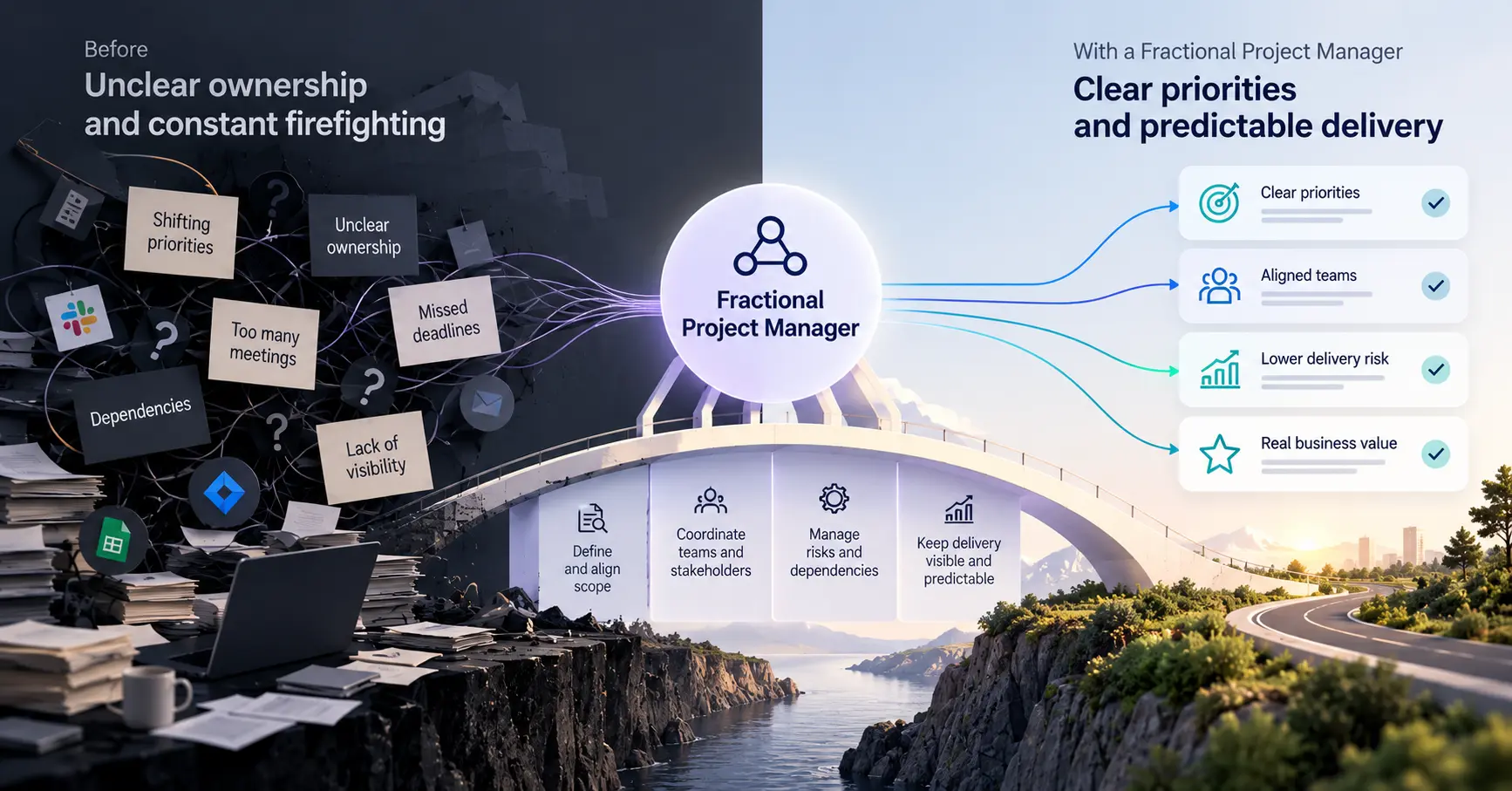
Why are companies using fractional project management?
The model exists because project management demand does not always arrive in neat forty-hour-per-week increments.
A growing SaaS company may suddenly have several parallel initiatives after a funding round. An agency may need experienced delivery leadership when client volume increases. A technology company may have capable engineers and product specialists but no dedicated person coordinating dependencies between them. Another organization may already have project managers but need senior support while recovering a difficult programme.
In each case, the underlying problem is not necessarily insufficient headcount. It is insufficient delivery capacity or ownership.
Fractional project management allows companies to add that capability without immediately redesigning the permanent organization around a need that may still be evolving.
There is also a broader shift in what organizations expect from project professionals. PMI's recent research emphasizes business acumen, stakeholder value and the ability to navigate complexity rather than treating project management as a purely administrative discipline. That makes seniority particularly important in fractional work because the PM has less time inside the organization and therefore needs to identify consequential issues quickly.
Need senior project leadership without another full-time role?
When does a company need a fractional project manager?
The clearest signal is usually not company size or revenue. It is the relationship between delivery complexity and the organization's ability to manage it.
When founders or senior leaders have become the project management layer
Early-stage companies often coordinate naturally because the team is small and communication is direct. That model becomes less effective as more people, clients, vendors and initiatives enter the system.
When a founder, CTO, COO or another senior leader is routinely chasing updates, resolving routine dependencies, organizing delivery meetings and translating information between teams, the company may already have a project management function. It simply happens to be performed by someone whose time should increasingly be spent elsewhere.
A fractional PM can absorb much of that coordination while keeping leadership involved in the decisions that genuinely require leadership authority.
When work is moving but delivery is becoming difficult to predict
A project does not need to be visibly failing before management support becomes valuable.
Repeatedly shifting dates, unclear ownership, late discovery of blockers, inconsistent reporting and frequent priority changes are often earlier symptoms of a delivery system losing predictability.
At this stage, a fractional PM can be more useful than waiting until the organization needs a formal recovery effort.
When several teams or vendors depend on one another
Complexity increases sharply when delivery crosses organizational boundaries. Product, engineering, QA, design, operations, clients and external suppliers may all be individually competent while the overall project still struggles because nobody owns the connections between them.
This is where project management creates leverage. The PM does not replace the specialists. They make sure that the work of those specialists can converge into an outcome.
When you need senior project expertise but not full-time capacity
Some organizations genuinely need experienced project leadership but cannot justify using that capability forty hours every week.
Hiring a less experienced full-time person simply because the workload does not justify a senior salary can create the wrong trade-off. A fractional model can instead provide fewer hours of more experienced judgment, provided the project can operate effectively with that level of availability.
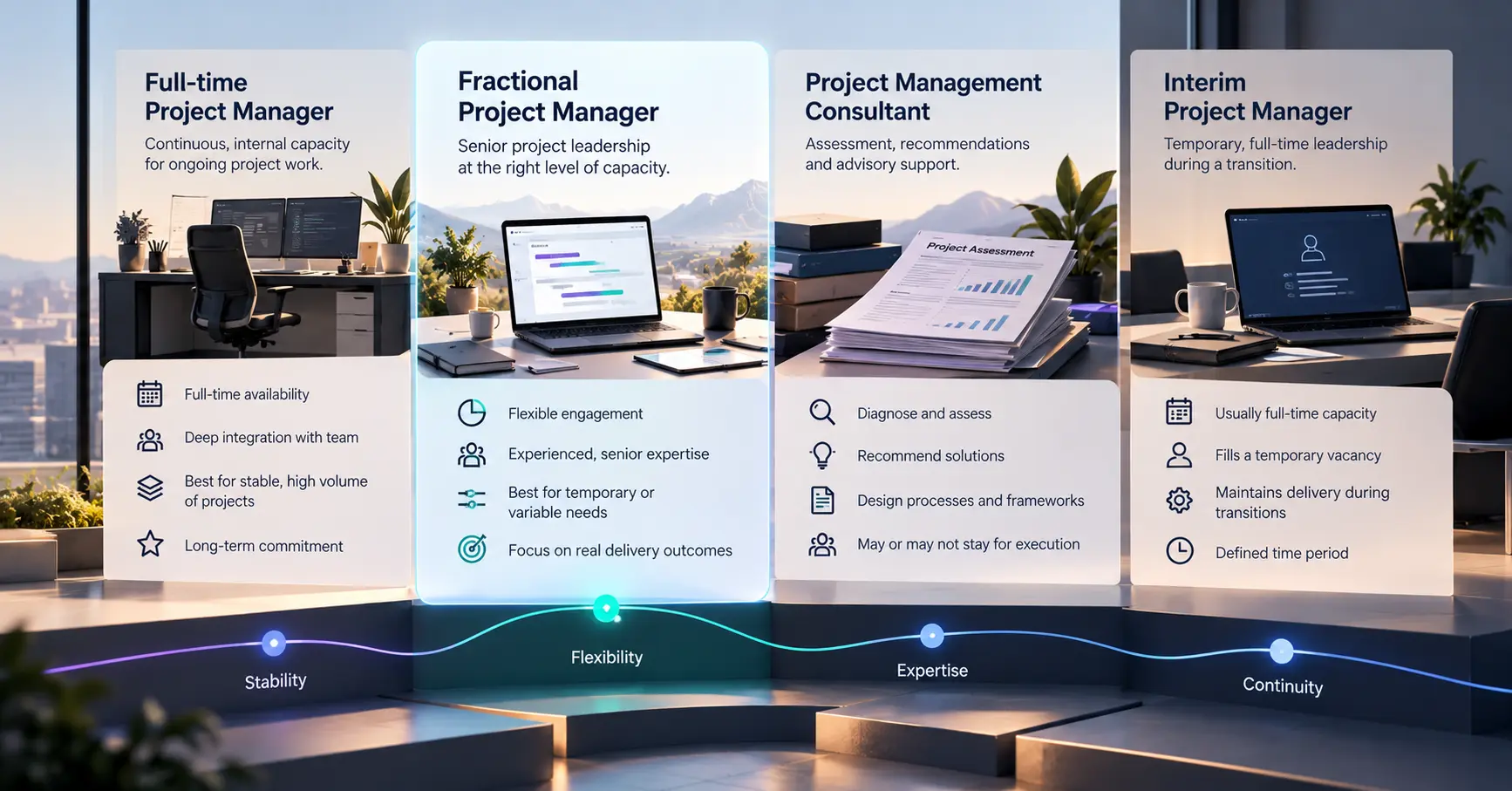
Fractional project manager vs full-time project manager
The difference is more significant than employment status.
A full-time project manager is usually the better option when project management represents a continuous, high-volume function inside the organization. If several teams require daily coordination, project volume is stable, leadership needs constant availability and there is enough work to occupy a capable PM throughout the week, permanent internal ownership is likely to make more sense.
A fractional PM is better suited to environments where the need is substantial but does not yet require that level of permanent capacity. The organization may need senior project leadership two days per week, intensive involvement during a launch, ongoing oversight across a small portfolio, or temporary help establishing a stronger delivery system.
The fractional model therefore optimizes for flexibility and seniority, while the full-time model optimizes for continuity and capacity.
Neither is inherently superior. The right decision depends on the operating environment.
Fractional project manager vs project management consultant
The terms overlap, which is why they are often confused, but the nature of the engagement can be different.
A project management consultant may be engaged primarily to diagnose a problem, recommend a new process, perform an assessment or design a governance model. The engagement can be extremely valuable even if the consultant does not subsequently own day-to-day delivery.
A fractional project manager normally stays closer to execution. They participate in the operating rhythm of the team, maintain visibility across the project, coordinate stakeholders and remain involved as decisions turn into work.
In practice, the strongest engagements may combine both models. A company may first need an assessment of its current delivery system and then require fractional leadership to implement the changes and stabilize the new way of working.
The important question is therefore not what the provider calls the service. It is whether you are purchasing advice, implementation, ongoing delivery ownership or some combination of the three.
Fractional PM vs interim PM
An interim project manager typically fills a temporary vacancy at approximately full-time capacity. The company may have lost an internal PM, be recruiting a replacement or need someone to occupy a defined role during a transition.
A fractional PM is intentionally part-time.
The organization is not temporarily filling a forty-hour role. It is deliberately buying less than full-time capacity because that is what the delivery environment requires.
This distinction matters when setting expectations. A fractional PM cannot be expected to provide permanent real-time availability while simultaneously being contracted for a fraction of a working week.
What should a fractional PM engagement look like?
Successful fractional work begins with a defined mandate.
Before the engagement starts, both sides should understand what the PM owns, which decisions remain with internal leadership, which projects or workstreams are included, what access the PM has to people and systems, how escalation works and how success will be evaluated.
Without those boundaries, a fractional engagement can quickly become an undefined collection of meetings and administrative tasks.
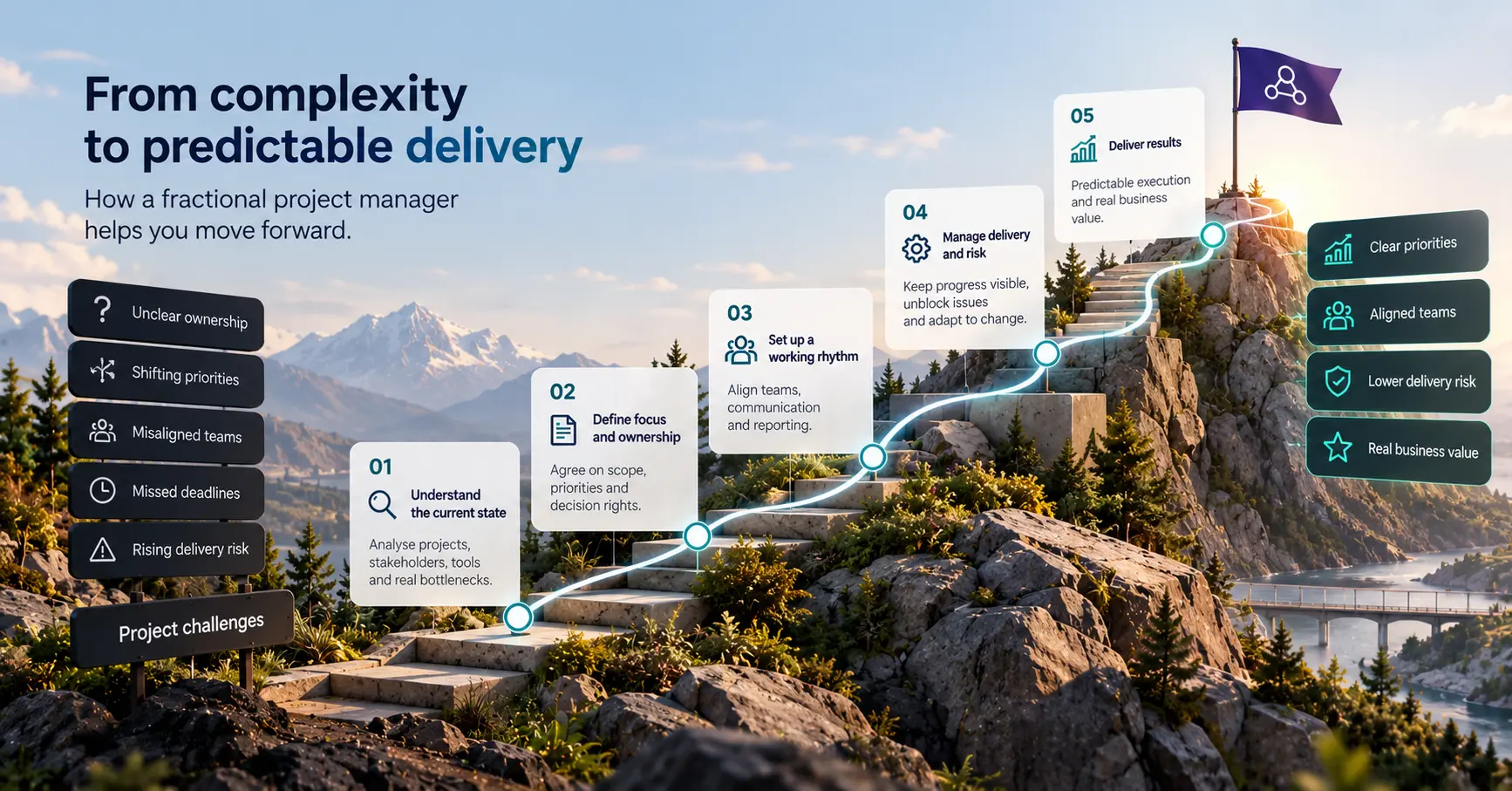
The first phase should establish the real delivery picture
A strong fractional PM normally begins by understanding the current state rather than immediately introducing a preferred methodology.
That means reviewing active initiatives, commitments, stakeholders, tools, dependencies, risks and existing ways of working. The PM needs to understand where information is lost, where decisions stall and which parts of the current system already work well enough to preserve.
The result should be a shared picture of the delivery environment and a small number of priorities for improving it.
The operating cadence should fit the company
There is no universal fractional PM methodology.
A SaaS product team working in short development cycles may need a very different cadence from a company managing a platform migration involving several external vendors. Agile, predictive and hybrid approaches can all be appropriate depending on the context.
The useful question is not whether the company is "doing Agile correctly." It is whether its way of working creates sufficient visibility, accountability and adaptability to deliver the intended outcome.
Decision rights must be explicit
This is one of the most overlooked parts of fractional project management.
A PM can identify a priority conflict, show its effect on delivery and facilitate a decision, but somebody must have the authority to make that decision. The same applies to budget changes, scope acceptance, resource allocation and vendor commitments.
Fractional leadership works poorly when responsibility is delegated without corresponding authority or access to someone who has that authority.
The client therefore remains an essential part of the delivery system. External project leadership cannot compensate indefinitely for decisions the organization itself is unwilling or unable to make.
What should a fractional project manager deliver?
The answer should depend on the problem rather than on a fixed template.
For one company, the highest-value outcome may be restoring control over a delayed product launch. For another, it may be establishing reliable portfolio visibility across several client projects. A third may need clearer ownership, a workable delivery cadence and a transition plan for an internal PM who will eventually take over.
Useful deliverables can include a baseline delivery plan, responsibility model, dependency map, risk and issue management process, stakeholder communication structure, reporting model, decision log, change process and handover documentation.
However, documents should be treated as mechanisms rather than outcomes.
The actual outcome is a delivery system in which the right people can understand what is happening, make decisions early enough and move work forward with less friction.
Not sure whether you need a fractional PM, a delivery audit or a full-time hire?
How much does a fractional project manager cost?
There is no useful universal price because fractional project management can describe substantially different engagements.
Pricing may be hourly, based on a fixed number of days each month, structured as a monthly retainer or attached to a defined project or phase. Seniority, project complexity, number of workstreams, stakeholder load, required availability, industry knowledge and delivery risk can all materially affect the price.
For that reason, comparing hourly rates alone can be misleading.
A relatively expensive senior PM who needs limited time to establish control may cost less overall than a cheaper resource who requires substantially more supervision and involvement. Conversely, a fractional arrangement becomes economically questionable when the organization consistently needs near-full-time availability.
The more useful calculation is therefore based on required capacity and outcomes: how much senior project management does the organization actually need, what problem should that capacity solve, and whether the requirement is temporary, variable or permanent.
When is a fractional project manager the wrong choice?
Fractional project management is not a universal substitute for hiring.
If the organization has enough ongoing project work to require daily management indefinitely, a full-time PM may provide better continuity and economics. If the role requires immediate availability throughout every working day, a genuinely fractional arrangement is unlikely to provide sufficient coverage.
It is also the wrong solution when the underlying problem is not project management.
A PM cannot compensate for the absence of product direction, replace missing engineering capacity or resolve fundamental leadership disagreements simply by introducing stronger project controls. Better coordination can make an existing strategy easier to execute, but it cannot make an unclear strategy correct.
There is another important limitation: fractional management requires cooperation from the organization itself. If stakeholders consistently avoid decisions, project information is inaccessible or the PM has responsibility without any meaningful authority, even an experienced project leader will eventually become another person documenting problems rather than solving them.
How to choose a fractional project manager
Start with the problem you need solved rather than a list of certifications.
Methodological knowledge matters, but fractional work places unusual demands on judgment. The person has to enter an unfamiliar environment, distinguish symptoms from underlying delivery problems and determine how much structure the organization can realistically absorb.
Relevant experience should therefore include evidence of managing comparable complexity, not merely using the same project management software.
Ask how the PM would approach the first few weeks, how they identify delivery risk, how they handle conflicting stakeholder priorities, what information they need from leadership and how they determine whether an existing process should be changed or left alone.
It is equally useful to ask what they would refuse to own.
A credible fractional PM should be comfortable defining boundaries because unclear ownership is precisely the problem they are supposed to help eliminate.
How do you measure whether fractional project management is working?
A busy calendar is not evidence of successful project management.
The engagement should improve observable aspects of delivery. Leadership should have a clearer view of project status. Decisions should happen with better information. Dependencies should surface earlier. Ownership should become easier to understand. Forecasts should become more credible, and stakeholders should spend less time reconstructing the state of the project from disconnected conversations.
Project-specific metrics may include milestone predictability, cycle time, unresolved blockers, scope change, decision latency, delivery risk, stakeholder satisfaction or progress toward a defined business outcome.
The exact metrics will vary, but they should connect project management activity to delivery performance rather than measuring how much project management activity occurred.
What happens when the company outgrows the fractional model?
That can be a successful outcome.
Fractional project management does not need to become a permanent dependency. As the organization grows, project volume may eventually justify a full-time project manager, delivery lead or broader PMO capability.
A good fractional engagement should make that transition easier rather than harder.
Processes should be understandable, project information should be accessible, responsibilities should be explicit and important knowledge should not exist only in the fractional PM's head. When an internal hire takes over, there should be a delivery system to inherit rather than a relationship to reverse-engineer.
In other organizations, demand may remain variable enough that fractional support continues to make sense over a longer period. The engagement can expand or contract as project complexity changes.
That flexibility is one of the model's primary advantages.
Fractional project management is really about right-sized ownership
The most useful way to think about fractional project management is not as outsourced administration and not simply as a cheaper alternative to hiring.
It is a way to introduce experienced delivery ownership at the level the organization currently requires.
For growing technology companies, that point often arrives when execution has become too complex to coordinate informally but project management demand is not yet large or stable enough to justify permanent senior capacity.
Used well, a fractional PM can create clearer ownership, stronger visibility and more predictable delivery while reducing the amount of project coordination carried by founders and other senior leaders.
Used poorly, the same model can simply add another participant to meetings.
The difference is usually found in the mandate: what the fractional PM owns, what authority they have, what outcomes matter and how deliberately they are integrated into the company's existing delivery system.
Conclusion
A fractional project manager gives organizations access to experienced project leadership without requiring them to build a full-time role before the need exists.
The model works particularly well when a company already has capable specialists but lacks consistent ownership across projects, dependencies and stakeholders. It can support growth, stabilize difficult delivery environments, provide leadership during periods of change and help organizations build stronger internal project management systems.
The important decision is not whether fractional project management is fashionable or less expensive than hiring. It is whether your current delivery problem requires senior ownership, how much of that ownership you actually need, and whether the person taking it on will have enough context and authority to make a difference.
When those conditions are clear, fractional project management can provide something more valuable than additional capacity: it can give a growing organization a more reliable way to turn plans into outcomes.
01What is a fractional project manager?
A fractional project manager is an experienced project professional who provides project and delivery leadership for part of their working capacity rather than joining the organization as a full-time employee. They may manage planning, risks, dependencies, stakeholders, reporting and delivery governance while working a defined number of hours or days per week or month.
02What is the difference between a fractional project manager and a full-time PM?
A full-time PM provides continuous internal capacity and is generally better suited to organizations with stable, ongoing project management demand. A fractional PM provides a defined portion of senior project management capacity, which can be more appropriate when demand is temporary, variable or substantial but not yet full-time.
03When should a startup hire a fractional project manager?
A startup should consider fractional project management when delivery complexity has outgrown informal coordination, founders or technical leaders are spending significant time managing execution, multiple teams or vendors need coordination, or important projects are becoming difficult to predict. If the company needs daily project leadership at full capacity, a permanent PM may be a better fit.
04Can a fractional project manager work with an existing team?
Yes. Fractional project management normally works best when the PM integrates with the existing team rather than creating a separate management layer. They can work with founders, product managers, engineers, QA specialists, operations teams, vendors and existing project managers while clarifying ownership and improving the delivery system around them.