



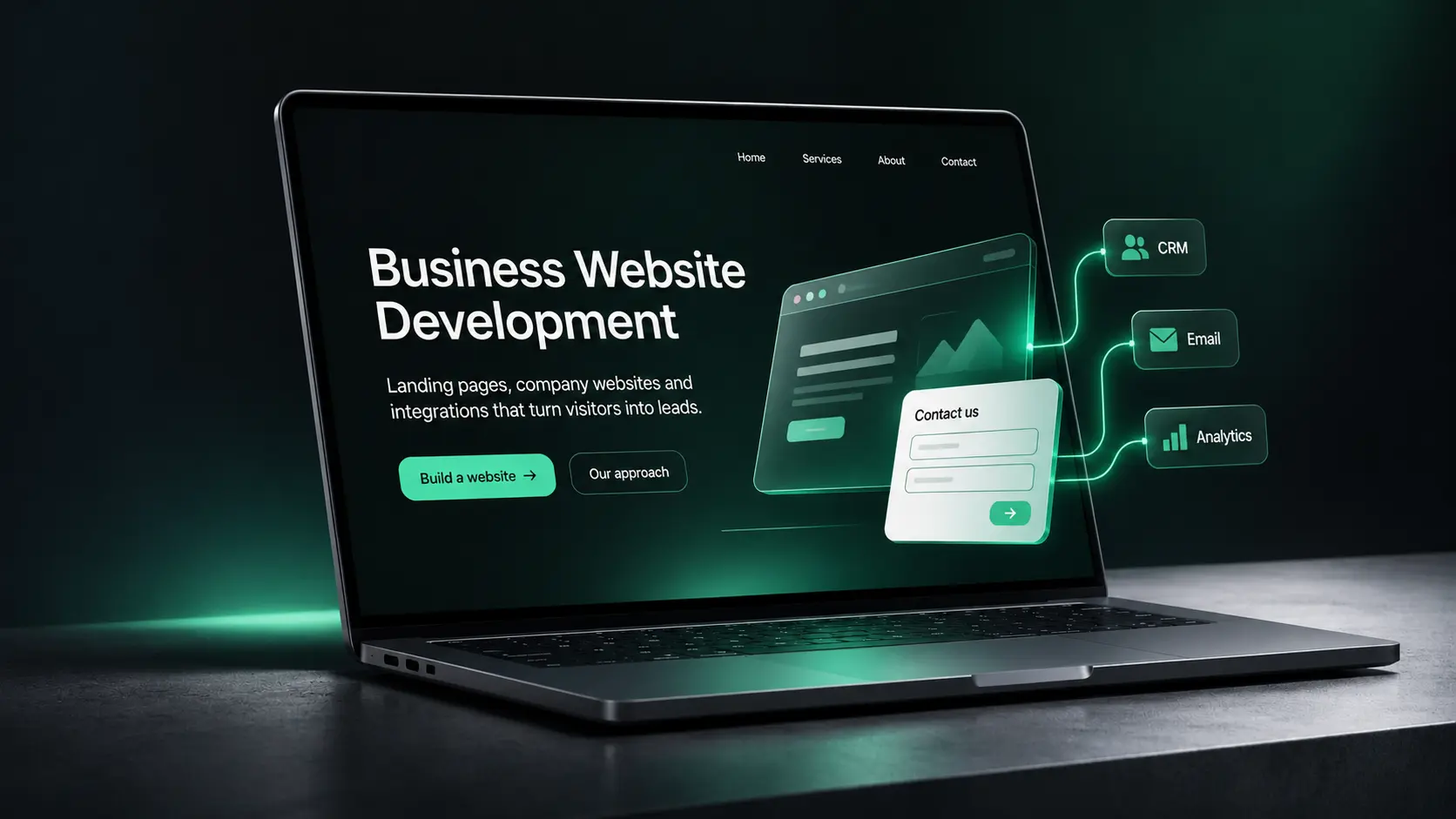
The interesting part begins when we stop thinking about the website as a collection of pages and start looking at what happens after somebody visits it.
When a company decides that it needs a new website, the conversation usually starts with pages. There should be a homepage, an About page, several service pages and, of course, a contact page. Perhaps a blog will be useful later. Someone starts thinking about colors and references, somebody else looks at competitors, and eventually a rough picture of the future website begins to emerge.
There is nothing wrong with starting there, but pages are only the visible part of a business website.
A more useful conversation starts with a different question: what is the website actually expected to do for the business?
Imagine that a potential customer discovers the company through Google, LinkedIn, an advertisement or a recommendation. They open the website, understand the offer, read about a particular service and decide to get in touch. At this point, the website has successfully done part of its job. What happens next, however, depends entirely on how the website has been built around the business.
The inquiry might simply arrive as an email. Someone will read it, copy the person's details into a CRM and tell a colleague that a new lead has arrived. That works, particularly when inquiries are rare. The same interaction can also be handled automatically: the form can create a lead in the CRM, preserve information about the service the visitor was interested in, notify the appropriate person and provide analytics with a successful conversion event.
From the visitor's perspective, both websites may look almost identical. From the company's perspective, they are very different systems.
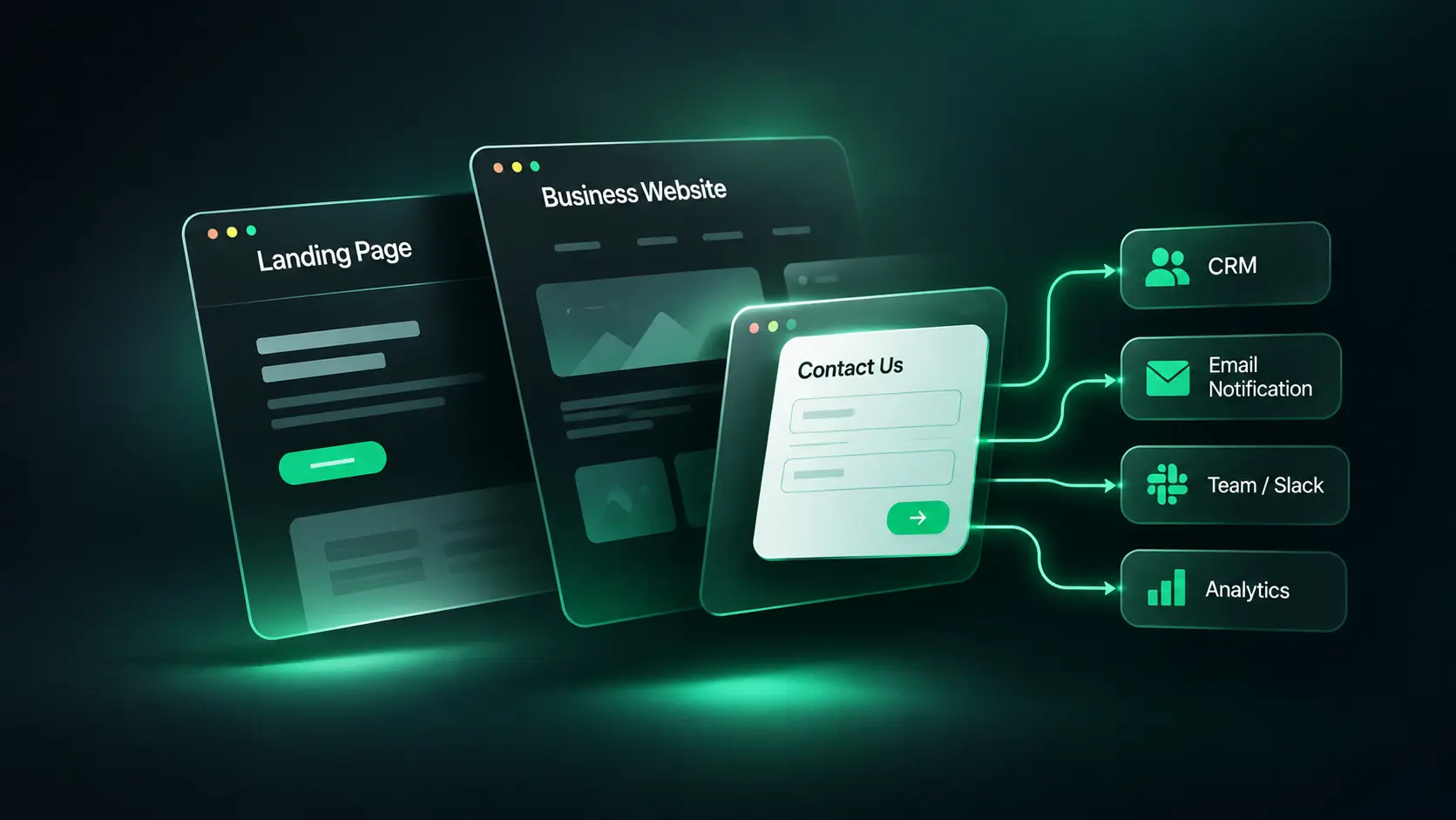
At PQOnix, this is how we prefer to think about business website development. The objective is to build the website the company actually needs, connect it with the processes behind it and avoid turning a relatively straightforward business requirement into an unnecessarily complicated software project.
Sometimes a Landing Page Is All You Need
There is an understandable temptation to make a new website feel substantial. Once development begins, it is easy to add another page, another section and another feature because they might become useful eventually. Before long, a simple requirement has turned into a much larger project.
For a young company, that can be exactly the wrong direction.
Suppose a startup is preparing to introduce a new product and needs somewhere to send potential customers. At this stage, the company may not need an extensive corporate website at all. It needs a clear explanation of the product, enough information to establish credibility and one obvious action for an interested visitor to take.
A well-designed landing page can do that extremely well.
The same applies to a consulting business introducing a new service, a company testing demand in a new market or a team preparing an advertising campaign. When there is one primary audience, one proposition and one desired action, concentrating everything on a focused landing page often makes more sense than building an entire website around a business that is still changing.
The challenge is not making the page large enough. It is making the message clear enough.
A visitor should be able to understand what the company offers, who the offer is intended for, why it might be relevant and what to do next without having to investigate the website like a puzzle. Good landing pages feel simple because the difficult decisions have already been made during planning.
As the business develops, however, that simplicity can eventually become restrictive.
Thinking about a new website for your business?
Discuss the roadmap with us
A Business Website Usually Grows With the Company
Imagine that the startup from the previous example survives its initial validation stage. It now has several services or product directions, customer stories, a growing team and enough expertise to begin publishing useful content.
Trying to fit all of that into one landing page stops making sense.
At this point, a small business website becomes useful because different visitors arrive with different questions. Someone evaluating the company wants to understand its services. Another person wants to know who is behind it. A potential client may be looking for evidence of previous work, while somebody arriving from search may have discovered an article before knowing anything about the company itself.
The structure naturally starts expanding into separate service pages, an About section, case studies, insights and other content that deserves its own context.
This is where the decisions made during initial development begin to matter. A website that was built as a rigid collection of pages can become surprisingly difficult to extend. Adding a new service may require duplicating layouts, changing navigation manually and fixing the same content in several places. A website built around reusable components and a sensible information architecture can grow much more naturally.
That does not mean designing an enormous architecture "for the future." It means avoiding technical decisions that make perfectly predictable changes unnecessarily expensive.
A company should be able to add another service next year without rebuilding its website.
The Most Interesting Part of a Contact Form Happens After "Submit"
A contact form looks almost trivial on screen. There are several fields, a button and perhaps a confirmation message after submission. Yet this small interface is often the point where the public website connects with the company's internal operations.
Consider a visitor who has just spent ten minutes reading about a service and decides to contact the company. They provide their name, company, email address and a short description of what they need.
If the form sends that information to a general mailbox, the website has technically completed its task. The company now has the inquiry.
The question is whether that is where the process should end.
If the company uses a CRM, somebody may have to create a new contact manually. If different people handle different services, somebody needs to decide who should receive the inquiry. If marketing wants to understand where good leads originate, information about the page, campaign or referral source needs to survive the handover. If a quick response is important, the responsible person needs to know that the inquiry has arrived.
None of this is particularly complicated, but together these small manual steps create friction.
A more useful workflow might begin with exactly the same form but continue behind the scenes. The submission creates a CRM record, records which service generated the inquiry, sends an internal notification and registers a conversion in analytics. The customer still sees a simple contact form. The business receives structured information that is immediately ready to use.
This is one of the reasons we do not treat website development and business operations as completely separate subjects.
A website is often the first point at which an external customer enters an internal business process.
CRM Integration Changes What Happens Behind the Website
CRM integration is a good example because the value is easy to understand.
Suppose a potential client named Alex works for Example Inc. and is interested in project delivery support. Alex completes the contact form and explains that the company has a delayed technology project.
Without an integration, that information arrives in someone's inbox. A person may then create a contact in HubSpot, Salesforce, Pipedrive, Bitrix or whatever CRM the company uses. They copy the name, email, company and message, select a lead source and perhaps assign the lead to somebody else.
It may take only a few minutes, but those minutes are repeated for every inquiry, and manual processes are rarely as consistent as they appear on paper.
With an appropriate integration, the website can pass the information directly to the CRM through an API, webhook or integration service. It can also include context that the visitor never had to enter manually, such as the page from which the form was submitted, the relevant service, campaign information or referral source.
Now the website is doing more than collecting a message. It is creating structured business data.
This becomes increasingly valuable as lead volume grows, but volume is not the only reason to do it. Even companies receiving a relatively small number of high-value inquiries can benefit from having a predictable process in which leads are recorded consistently and do not depend on somebody remembering to transfer information from an inbox.
A Website Can Connect to Much More Than a CRM
Once a website is viewed as the beginning of a workflow, other integrations become easier to think about.
A consultation request might create a lead and immediately notify the responsible person in Slack or Microsoft Teams. A newsletter subscription might go directly into the company's email platform. A demo request could be routed according to region or product. A booking flow might connect with a scheduling system, while an internal API could receive structured information required by another business process.
The useful question regarding integrations and automation is "What currently happens manually after somebody performs this action?"
If an integration removes a repetitive step, reduces the chance of losing information or helps the right person respond more quickly, it has a clear purpose. If it merely adds another tool to the architecture without improving the process, it probably does not belong there.
This distinction matters because modern website development makes it technically possible to connect almost anything to anything else. Technical possibility is not the same as business value.
The best integrations are often the ones visitors never notice.
The Website Still Needs to Be Easy to Change
Launch day tends to receive most of the attention during a website project, but the months after launch are usually a better test of whether the implementation was sensible.
Companies rarely remain static. A service is renamed. A new team member joins. An old case study becomes irrelevant. Marketing wants a campaign page. Somebody notices that a paragraph no longer describes the product correctly. Eventually, the company decides to start publishing articles.
If every one of those changes requires a developer to modify source code, even a technically excellent website can become frustrating to operate.
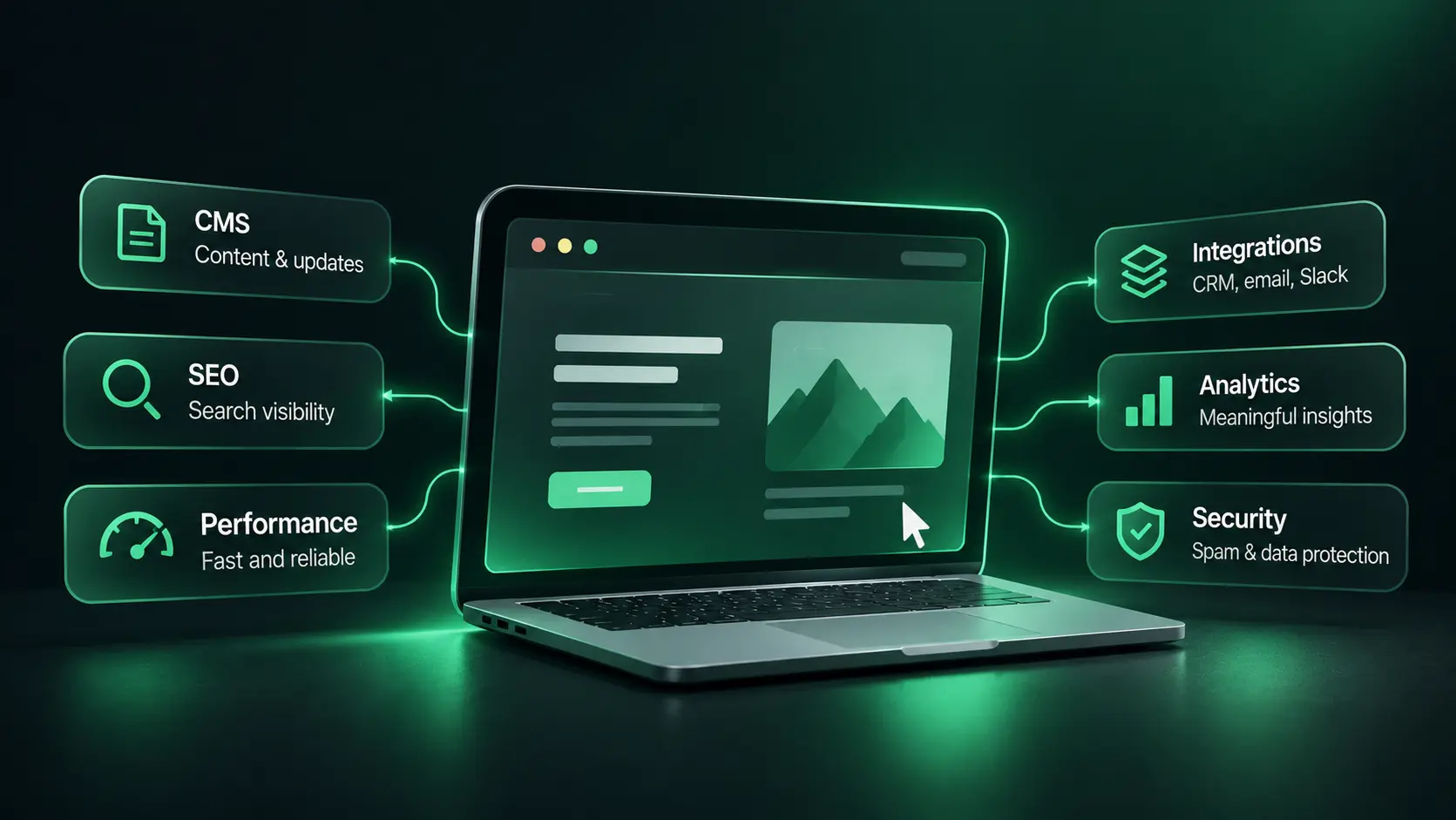
This is where a content management system can be useful. A CMS can give the people responsible for the website control over articles, services, case studies, team profiles, FAQs, metadata and other content without exposing them to the implementation behind it.
However, a CMS is not automatically a requirement.
A small landing page that changes twice a year may be easier to maintain without one. Adding a content management layer to a website whose content almost never changes can create more administration than value.
The decision should come from the expected workflow after launch. Who will update the website? How often? What will they need to change? Will marketing create new pages regularly? Is content part of the company's acquisition strategy?
Once those questions are answered, the technical choice becomes much clearer.
Good Business Websites Are Often Technically Boring
There is a strange tendency in web development to confuse technical complexity with quality.
A company website can have elaborate animations, a sophisticated JavaScript stack and a large collection of third-party scripts while still taking too long to load, behaving poorly on mobile devices and making basic content difficult to find.
For most business websites, visitors do not care how technically impressive the implementation is. They care whether the website loads quickly, works on their device, explains what the company does and lets them complete whatever action brought them there.
That makes performance a business requirement rather than a purely technical metric.
Images need to be appropriately optimized. Layouts should remain stable while pages load. Interactive elements should respond quickly. Third-party scripts should have a reason to exist. Mobile users should not receive a compromised version of the experience simply because the original design was created on a large desktop screen.
The same principle applies to the underlying architecture. A five-page consulting website does not need to behave like a global SaaS platform internally. The simplest architecture capable of meeting the actual requirement is often the better engineering decision.
SEO Begins Before the Website Is Published
Search engine optimization is another area that is often treated as something to add after development.
A website gets designed, built and launched, and only then does someone begin asking whether the URLs are correct, whether pages can be indexed and whether search engines understand the structure.
By that point, some of the most important decisions have already been made.
Technical SEO begins with the way the website itself is organized. Pages need meaningful URLs and sensible relationships with one another. Headings should reflect the content hierarchy. Titles, descriptions and canonical URLs need to be handled consistently. Search engines need a sitemap and clear indexing directives. Images need appropriate alternative text. Structured data can help describe certain types of content. Internal links should make important information discoverable.
Performance and mobile usability belong in the same conversation because the technical experience of the website affects both users and search visibility.
None of these elements guarantees rankings, and SEO should never be reduced to a checklist of tags. What they provide is a sound technical foundation so that future content and marketing work are not fighting against the website itself.
This becomes particularly important for companies that expect their website to grow into an acquisition channel. If the plan includes publishing expertise, targeting service-related searches or building topical authority over time, the architecture should allow that strategy to develop naturally.
Need an effective and well optimized website?
Our expertise can help you achieve your first clients!
Analytics Should Explain More Than Traffic
A similar problem occurs with analytics.
It is easy to install an analytics platform and start collecting page views. After a few months, the company may have plenty of numbers without knowing much more about whether the website is helping the business.
Five thousand visits sound interesting, but the more useful questions are usually closer to the actual customer journey.
Which service pages lead to inquiries? Which acquisition channels produce visitors who eventually make contact? Do people read an article and later explore a commercial page? Where do potential customers leave the journey? Which calls to action are actually used?
When analytics is designed around these questions, the website begins to provide information that can influence business decisions.
For example, a visitor might arrive through an article, move to a service page, open the contact form and submit an inquiry. Understanding that sequence is far more valuable than seeing three unrelated page views in a dashboard.
The same thinking applies to campaign landing pages. If a company is paying to bring traffic to a page, measurement should be designed around the action the campaign is supposed to produce.
Analytics becomes useful when it follows the business logic of the website rather than merely counting activity.
Small Websites Still Need Real Security
A website does not become irrelevant to attackers simply because it contains only a few pages.
Public contact forms attract automated spam. APIs can be abused. Credentials can be exposed through poor configuration. Dependencies can develop vulnerabilities. Content management systems can be misconfigured, and an apparently harmless form can become an entry point for unwanted traffic.
The appropriate response is not to turn every marketing website into a security engineering project.
It is to apply basic engineering discipline.
Communication should be encrypted. Forms should be validated properly and protected against automated abuse where appropriate. API credentials should remain on the server rather than appearing in browser code. Access to content management systems should be controlled. Dependencies should be maintained, and integrations should receive only the permissions they actually require.
Security is much easier to manage when it is considered during implementation rather than added after something goes wrong.
So What Does a Company Actually Need?
By this point, it should be clear why we prefer to start website projects with business questions rather than a technology stack.
A company might initially say that it needs a six-page website. After a short discussion, the actual requirement may turn out to be more specific: potential customers need to understand three services, marketing needs to publish articles, sales needs every inquiry in HubSpot, the team needs an immediate notification when a qualified lead arrives, and management wants to know which channels generate those inquiries.
That is a much better description of the project.
It tells us what information the website needs to communicate, what actions matter, what should happen after those actions, who needs to manage the content and what the company needs to measure.
Only then does it make sense to decide whether the website needs a CMS, what kind of form handling is appropriate, how the CRM integration should work and what technical architecture can support the requirements without becoming unnecessarily complicated.
Technology follows the workflow.
The Right Website Is Usually Smaller Than the Imagined One
One of the most useful outcomes of proper planning is discovering what does not need to be built.
A small company website may not need a custom backend. It may not need user accounts, a database, an elaborate administration panel or a complicated collection of services. Existing platforms can often handle scheduling, email delivery, CRM, analytics and other functions more reliably than custom replacements.
Building less is not a compromise when the smaller solution meets the requirement better.
Consider a consulting company launching a new website. It may need several strong service pages, an About section, a contact form, CRM integration, analytics and a foundation for future content. That is already enough to create a serious business website.
A startup validating a new product may need even less: one focused landing page, a convincing explanation, a demo or waitlist form and enough measurement to understand whether people are interested.
Another company may already know that content will become an important acquisition channel. In that case, adding a CMS, an insights section and scalable SEO architecture from the beginning is reasonable because those capabilities correspond to a real plan.
The scope changes because the business changes, not because one implementation is inherently more professional than another.
When External Website Development Makes Sense
Some companies can and should build their websites internally. If a team already has design and development capacity and the website is strategically important enough to justify that capacity, there may be little reason to involve an external partner.
The situation is different when the internal product team already has a backlog of product work, when a new company needs to establish a credible presence quickly, or when marketing needs a website without turning it into another long-running internal software initiative.
External support can also make sense when the requirement crosses several areas at once. The visible website may be straightforward, but it still needs to work with a CRM, analytics, content management, hosting, SEO requirements and the company's existing processes.
In these situations, the value is not simply having someone write the code.
The value is being able to take the requirement from "we need a new website" to a working system without making the company coordinate every technical detail itself.
Launch Should Be the Beginning of the Website's Useful Life
There is a simple way to judge many website decisions: imagine what happens six months after launch.
The company has introduced a new service. Marketing wants a dedicated page for it. Three new articles are ready for publication. The contact process has changed and inquiries now need to be routed differently. A new CRM field should be populated from the website. Someone wants to understand why one service generates considerably more leads than another.
Can the website accommodate these changes without becoming a new development project every time?
If the answer is yes, the original architecture probably did its job.
A well-built business website should be able to evolve without becoming increasingly fragile. New content should fit into the existing structure, integrations should be replaceable or extendable, and the company should retain control over the parts of the website it needs to manage regularly.
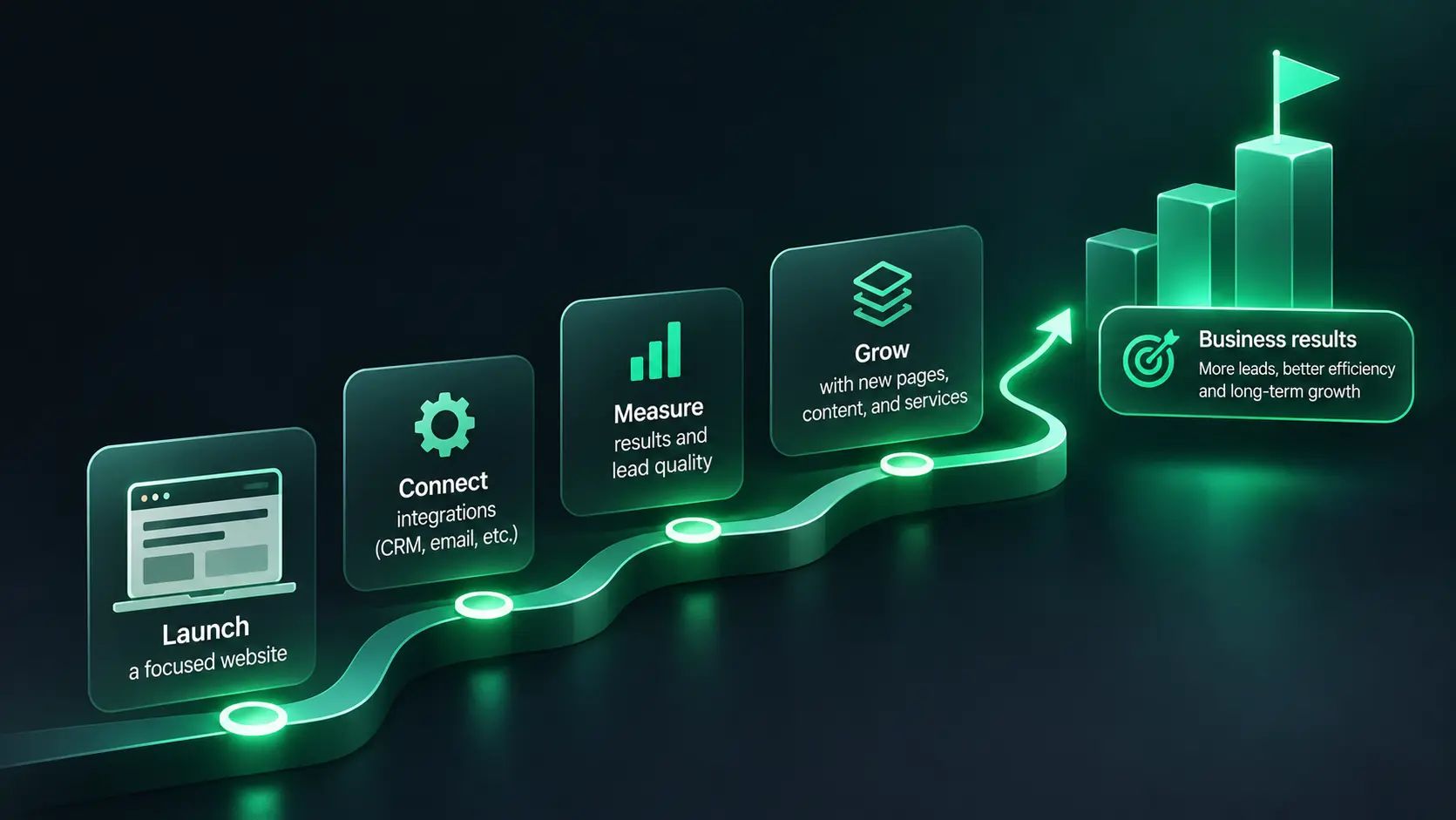
This is what scalability means for many business websites. It is not about preparing for millions of users. It is about making ordinary business changes inexpensive and predictable.
A Website Is the Beginning of a Business Process
From the outside, a modern business website can remain remarkably simple.
A visitor arrives, understands the company, explores a service and sends an inquiry.
Behind those few steps, however, several things may be happening. The website presents structured content, supports search visibility, records useful analytics, protects the form from abuse, sends information into a CRM and alerts the right person that a potential customer wants to talk.
The visitor does not need to see any of that complexity.
In fact, they probably should not.
Good website development hides the machinery and leaves the user with a clear experience.
That is the approach behind PQOnix website development. We build focused landing pages and business websites for companies that need more than an attractive online presence. Where the business requires it, the website can connect with contact workflows, CRM systems, analytics, content management and other tools already used by the team.
The result does not have to be a large website.
It has to be a useful one.
If your company is planning a new website, replacing an outdated one or needs a landing page connected to the way your sales and marketing actually work, start a conversation with PQOnix.
01How much does it cost to build a business website?
The cost depends on the scope, design requirements, number of pages, content management needs, and integrations involved. A focused landing page with a contact form is considerably simpler than a multi-page business website connected to a CRM, analytics, CMS, and other services. The most reliable way to estimate the cost is to define what the website needs to accomplish first and determine the technical scope from those requirements.
02Does a business website need a CMS?
Not necessarily. A CMS is useful when a company expects to update services, publish articles, manage case studies, create new pages, or regularly change website content without developer involvement. For a small landing page or a website that changes rarely, a CMS may introduce unnecessary complexity. The decision should depend on how the website will actually be managed after launch.
03Can a website contact form be connected to a CRM?
Yes. Contact forms can be integrated with CRM systems such as HubSpot, Salesforce, Pipedrive, Bitrix, or other platforms through APIs, webhooks, or integration services. Instead of simply sending an email, a form submission can create a lead, preserve information about its source, assign it to the appropriate person, trigger notifications, and record the conversion for analytics.
04What is the difference between a landing page and a business website?
A landing page is usually built around one audience, offer, or conversion goal and is often suitable for product launches, campaigns, new services, or early-stage businesses. A business website provides a broader structure for companies that need separate service pages, company information, case studies, content, SEO growth, and multiple customer journeys. The right choice depends on what visitors need to understand and what the business expects the website to achieve.