




What Is a Discovery Call in IT Consulting?
A discovery call is usually the first structured conversation between a company and an IT consulting partner. Its purpose is to understand the situation before recommending a service, changing a process, introducing new management practices, or committing resources to an engagement.
This distinction is particularly important in consulting because the problem described during the first conversation is not always the actual problem that needs to be solved.
A company may initially say that it needs more QA capacity because releases contain too many defects. Further investigation may reveal that testing itself is not the primary constraint. Requirements may reach QA too late, acceptance criteria may be incomplete, release ownership may be unclear, environments may be unstable, or teams may be operating without an effective quality strategy.
The same applies to project delivery. A company experiencing repeated delays may assume that developers need tighter management, while the underlying issue could be uncontrolled scope, weak estimation, unresolved dependencies, fragmented stakeholder communication, or the absence of clear ownership.
Discovery therefore begins with understanding the operating environment rather than immediately prescribing a solution.
This principle is consistent with established discovery practices. Thoughtworks describes discovery as an opportunity to understand both the technological and organizational context surrounding a problem, while Atlassian emphasizes understanding the problem, evidence, impact, feasibility, and strategic relevance before committing to a solution.
Why Discovery Matters in IT Consulting
Consulting becomes ineffective when recommendations are based primarily on symptoms.
If releases are frequently delayed, adding another project manager may not solve the problem. If production defects are increasing, adding more manual testers may not address the underlying quality gaps. If teams spend excessive time coordinating routine work, introducing another management tool may simply add another layer of process.
A discovery call provides the first opportunity to distinguish symptoms from causes.
For a consulting company such as PQOnix, this means understanding not only what the client wants to improve, but how work currently moves through the organization. The conversation may cover quality assurance, project governance, delivery processes, responsibilities, communication patterns, workflows, existing tools, documentation, dependencies, and operational bottlenecks.
The objective is not to diagnose an entire organization during one meeting. It is to determine which areas are sufficiently understood, which assumptions need validation, and where deeper assessment may be necessary.
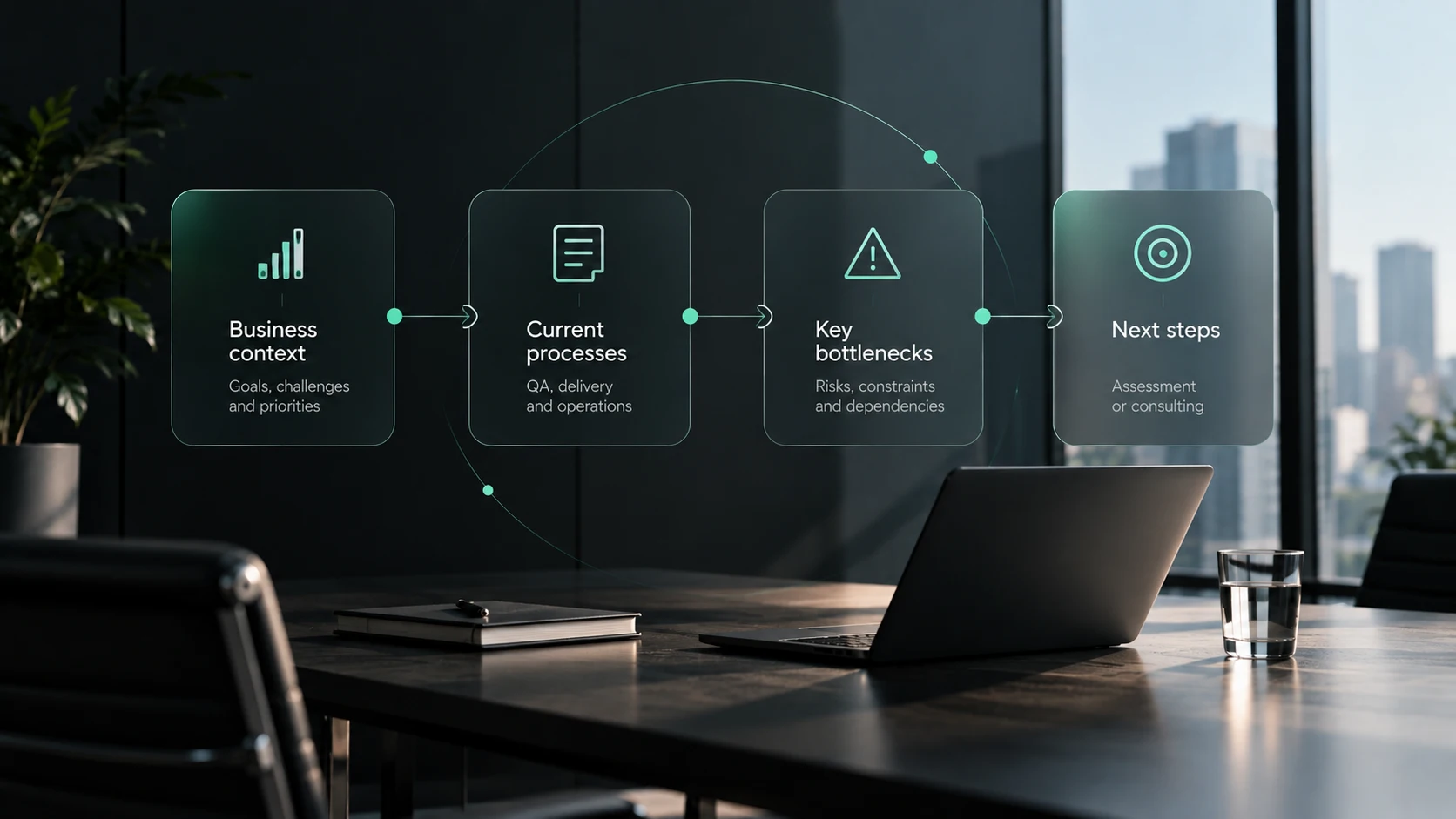
Understand the problem before investing in the solution.
Discovery Call vs. Audit vs. Consulting Engagement
These three stages are related, but they serve different purposes.
A discovery call is primarily exploratory. It establishes the business context, identifies visible problems and constraints, and determines whether there is enough information to recommend a next step.
An audit goes deeper. Depending on the engagement, consultants may review processes, documentation, Jira or other project data, test strategies, test cases, release workflows, responsibilities, reporting practices, existing metrics, stakeholder communication, and other evidence that cannot be properly evaluated during an introductory conversation.
A consulting engagement moves from understanding the situation toward improving it. This may involve designing processes, establishing QA practices, improving project governance, defining ownership, restructuring workflows, introducing reporting, supporting delivery, or helping internal teams implement recommendations.
The discovery call therefore does not need to produce every answer. Its job is to establish what needs to be understood next.
What Happens During an IT Consulting Discovery Call?
A productive discovery call should follow a logical progression from business context to current processes, problems, consequences, constraints, and expected outcomes. It should still feel like a conversation rather than an interrogation based on a generic questionnaire.
1. Understanding Why the Conversation Is Happening
The first question is not which service the company wants to purchase. It is why the company is looking for external support now.
There is usually a trigger.
A growing product company may find that processes that worked with ten employees become unreliable with thirty. A business may be experiencing recurring production issues. Projects may repeatedly miss deadlines. Management may have insufficient visibility into delivery. Responsibilities may have become fragmented as the organization expanded.
Understanding that trigger provides context for everything that follows.
It also establishes the business consequences of the problem. A delivery issue that creates occasional internal inconvenience is fundamentally different from one that delays customer launches, increases churn, consumes management capacity, or creates contractual risk.
2. Defining the Problem Behind the Request
Clients frequently approach consultants with a proposed solution already in mind.
“We need a QA lead.”
“We need someone to manage delivery.”
“We need better processes.”
“We need to organize Jira.”
These statements are useful starting points, but they do not constitute a diagnosis.
A discovery conversation should examine what led the organization to that conclusion. If management believes it needs stronger QA leadership, the consultant needs to understand how quality is currently managed, when testing begins, who defines acceptance criteria, how releases are approved, what types of defects occur, and where responsibility for quality sits.
The objective is not to challenge the client unnecessarily. It is to ensure that the engagement addresses the problem rather than merely the most visible symptom.
3. Understanding the Current Operating Model
Consulting recommendations need to fit the organization that will actually use them.
The discovery call should therefore establish how teams are structured, how work enters the system, how priorities are determined, how projects move from requirements to delivery, how quality is controlled, and how stakeholders receive information about progress.
Existing tools also matter, but they should be understood in context. Jira, Confluence, Slack, a CRM, spreadsheets, dashboards, or test management platforms do not create good processes by themselves. The relevant question is how these systems support the workflow and where information or ownership breaks down.
For operational consulting, the conversation may extend beyond product delivery into internal workflows, handoffs, recurring administrative work, documentation, reporting, communication channels, and management routines.
4. Identifying Stakeholders and Ownership
Many delivery problems are ownership problems in disguise.
A process can look reasonable on paper while repeatedly failing because nobody has clear responsibility for a critical decision. Requirements may have several contributors but no final owner. QA may be responsible for identifying defects but have no authority over release readiness. Project managers may track deadlines without having control over dependencies or priorities.
Discovery should therefore clarify who makes decisions, who performs the work, who approves outcomes, and who needs visibility.
This is particularly important when several departments or external vendors participate in the same delivery process.
5. Examining Quality Assurance Practices
When QA is relevant to the engagement, discovery should examine quality as a system rather than simply counting testers.
The conversation may cover when QA becomes involved, how requirements are reviewed, whether test planning exists, how regression is handled, how defects are classified and prioritized, what happens before a release, how production incidents are analyzed, and whether quality metrics provide useful information to management.
A mature quality approach also considers where defects originate. If the majority of critical issues result from ambiguous requirements or rushed scope changes, increasing the volume of testing alone will not eliminate the source of the problem.
This is where senior QA expertise can be substantially more valuable than simply adding testing capacity.
Find the quality gaps behind recurring delivery problems.
6. Understanding Project and Delivery Management
When the concern involves deadlines, predictability, workload, or stakeholder visibility, discovery should examine how delivery is actually managed.
This includes planning and estimation, prioritization, dependency management, scope changes, risk management, team capacity, status reporting, escalation, and decision making.
The consultant should also understand how often plans diverge from reality and what happens when they do.
A team that occasionally misses an estimate may not have a serious delivery problem. A team that consistently carries unfinished work between sprints, changes priorities continuously, discovers dependencies late, and cannot explain when an initiative will realistically finish has a different problem.
Effective discovery separates those situations instead of applying the same project management framework to both.
7. Looking for Operational Bottlenecks
Not every organizational problem belongs exclusively to QA or project management.
Companies accumulate operational friction as they grow. Information is duplicated between systems. Reports are assembled manually. Routine requests depend on particular employees. Important procedures exist only as institutional knowledge. Different departments maintain conflicting versions of the same information.
Individually, these problems may appear minor. Collectively, they consume management attention and reduce organizational capacity.
During discovery, it is useful to understand which recurring processes require disproportionate manual coordination, where handoffs frequently fail, and which workflows depend heavily on individual employees.
The objective is not to introduce processes everywhere. It is to identify where better structure would remove unnecessary operational load.
8. Understanding Constraints
Recommendations that ignore constraints rarely survive implementation.
The discovery conversation should therefore establish what cannot easily change. This may include budget, existing contracts, regulatory requirements, customer commitments, technology dependencies, team availability, organizational structure, deadlines, or limitations imposed by other departments.
There may also be cultural constraints. A theoretically efficient process that requires a company to change its entire operating model is unlikely to succeed if the organization has neither the capacity nor the need for that transformation.
Good consulting works within reality rather than designing an ideal organization that exists only in documentation.
9. Establishing the Desired Outcome
A consulting engagement needs a definition of improvement.
“We want better project management” is difficult to evaluate. A more useful objective might be increasing delivery predictability, reducing unplanned work, creating management visibility across projects, clarifying ownership, or establishing a repeatable planning process.
The same principle applies to QA. The goal may involve reducing critical production defects, establishing consistent release criteria, improving test coverage of business critical workflows, introducing a test strategy, or giving management reliable information about product quality.
Operational improvements may target shorter processing time, fewer manual handoffs, clearer responsibilities, or reduced dependency on individual employees.
The discovery call should begin translating general dissatisfaction into outcomes that can eventually be evaluated.
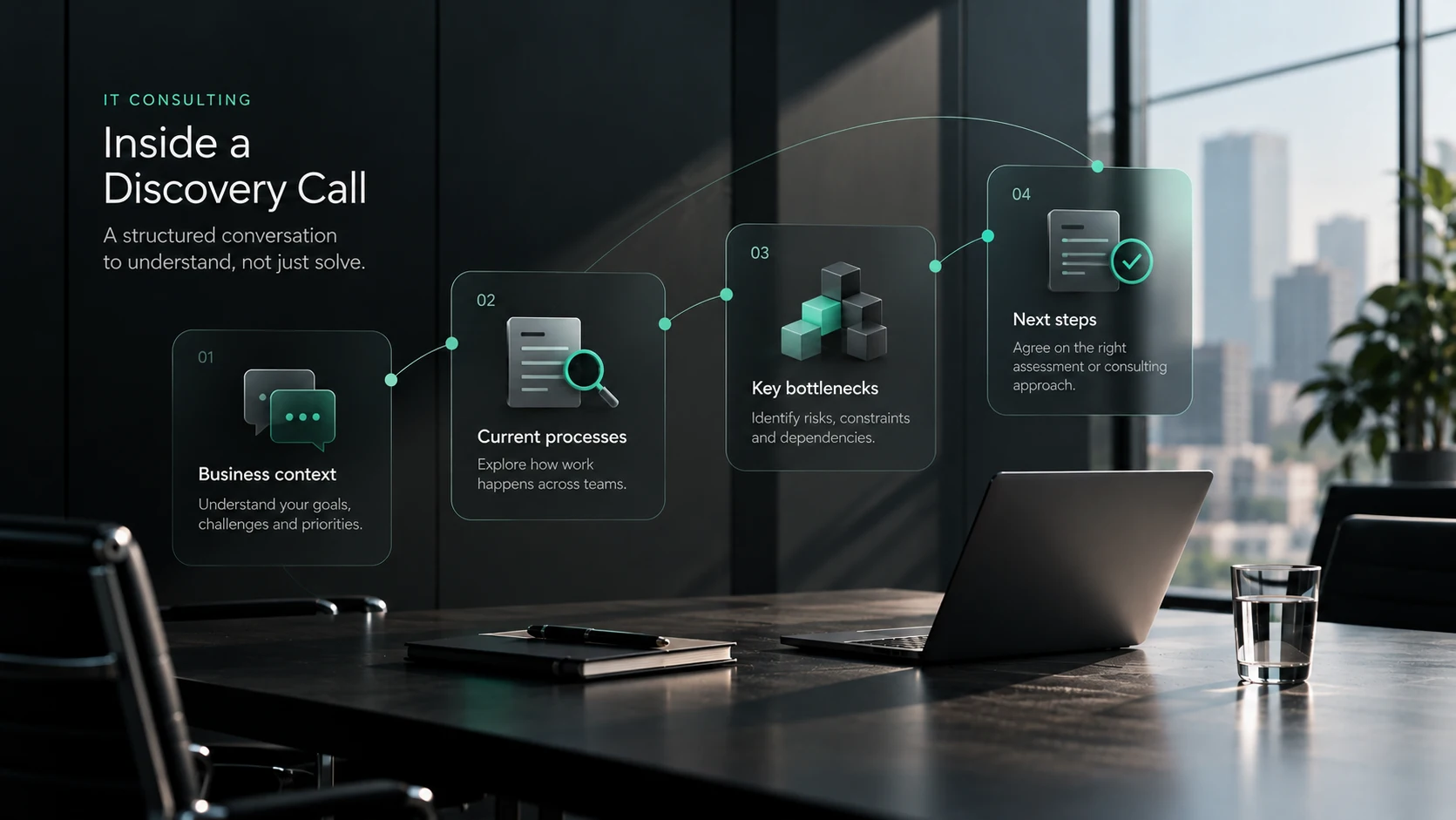
What Questions Are Asked During an IT Consulting Discovery Call?
There is no universal discovery questionnaire because the questions should follow the client's situation.
A QA focused conversation will naturally explore different areas from a delivery management assessment. However, most useful discovery conversations seek to establish several fundamental things: what is happening, why it matters, how the organization currently handles it, who is involved, what has already been attempted, what constraints exist, and what a successful outcome would look like.
The consultant should also look for inconsistencies between the perceived problem and the available evidence.
For example, management may describe the primary issue as slow development while delivery data indicates frequent scope changes. A QA team may appear overloaded while much of its capacity is actually being consumed by unstable requirements and repeated retesting. Project managers may appear ineffective while priorities are being changed by multiple stakeholders without a defined decision process.
Discovery becomes valuable when it reveals these relationships.
Who Should Participate in the Discovery Call?
At least one participant should be able to explain why the problem matters to the business, while other participants should understand how the relevant processes operate in practice.
Depending on the situation, this may involve a founder, CTO, COO, Head of Product, delivery manager, project manager, QA lead, operations manager, or another responsible stakeholder.
Not every person needs to attend the first meeting. In fact, trying to include everyone can make an initial discovery call less productive.
The first conversation should instead identify whose knowledge will be required if the investigation continues. A subsequent audit or assessment can then involve the appropriate process owners, team members, and technical specialists.
What Should Come Out of a Discovery Call?
The most useful outcome is clarity about the next decision.
Sometimes the discovery call confirms that the problem is sufficiently defined and the appropriate consulting service is obvious. In other cases, the conversation reveals that a recommendation would be premature without examining processes, documentation, project data, QA practices, or stakeholder perspectives.
The next step may therefore be a focused QA audit, a project delivery assessment, an operations review, additional stakeholder interviews, or a broader consulting engagement.
A responsible consultant should also be prepared to conclude that a client does not need a substantial engagement. Discovery is valuable partly because it prevents organizations from investing in services that do not address their actual constraints.
What Does PQOnix Look for During Discovery?
At PQOnix, discovery is focused on three interconnected areas: quality, delivery, and operations.
Quality examines whether the organization has enough visibility and control to release software with confidence. This includes QA strategy, requirements, testing practices, release processes, defect patterns, responsibilities, and quality related risks.
Delivery examines how work moves from intention to completion. It includes planning, prioritization, estimation, dependencies, risk management, stakeholder communication, ownership, and management visibility.
Operations examines the processes surrounding delivery and the broader organization. This can include recurring workflows, information handoffs, documentation, reporting, coordination, and operational dependencies that consume unnecessary time or create avoidable risk.
These areas are deliberately considered together because organizational problems rarely respect departmental boundaries. A quality problem can originate in project management. A delivery problem can originate in operations. An operational bottleneck can affect both.
The purpose of discovery is to determine where the constraint actually sits.
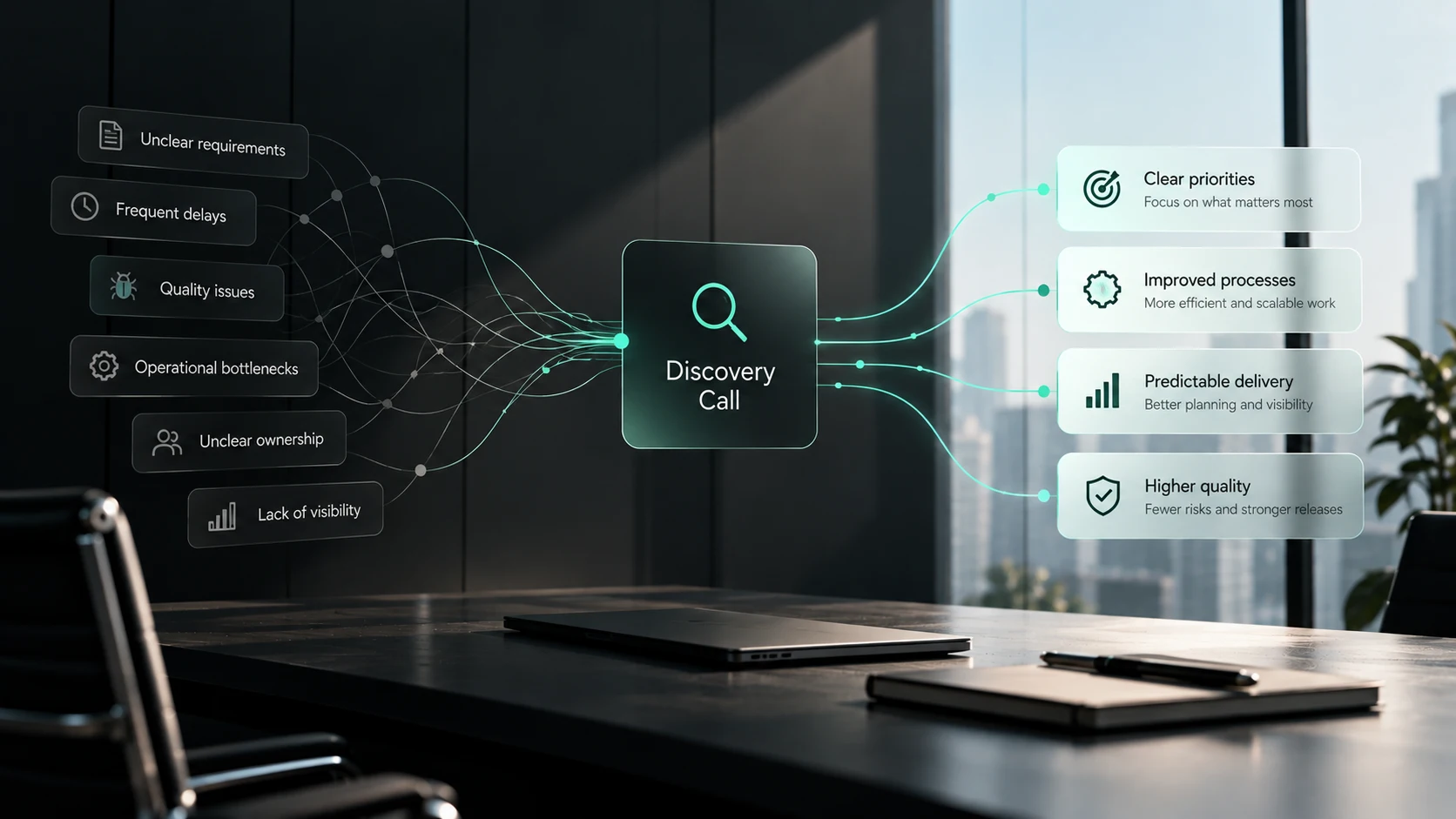
Get an independent view of your delivery environment.
Common Discovery Call Mistakes
Treating the Call as a Sales Presentation
A discovery call should not be dominated by a consulting company's capabilities deck.
The consultant needs enough information to understand whether there is a meaningful problem to solve and whether their expertise is appropriate. Explaining relevant experience is useful, but it should support the conversation rather than replace discovery.
Accepting the Initial Diagnosis Without Investigation
Clients understand their businesses better than external consultants, but they are also operating inside the systems being examined.
The problem they identify should therefore be taken seriously without automatically assuming that its underlying cause has already been established.
An external perspective creates value precisely because it can examine relationships between processes that internal teams may have become accustomed to.
Recommending More Process by Default
Consulting does not become more valuable when it produces more meetings, documentation, statuses, or procedures.
Every additional control has a cost. The relevant question is whether it reduces enough risk, ambiguity, or operational effort to justify that cost.
In some organizations, the correct recommendation may actually be to remove unnecessary process.
Trying to Solve Everything During the First Call
A discovery call is not an audit.
Some conclusions require evidence that cannot be obtained through conversation alone. Project data may need to be examined, documentation reviewed, workflows observed, or additional stakeholders interviewed.
Recognizing that more evidence is required is not a failure of discovery. It is often one of its most important findings.
From Discovery to Assessment and Improvement
Discovery should ultimately lead to a proportionate next step.
A clearly defined problem may require focused consulting support. A poorly understood quality environment may justify a QA audit. Repeated delivery failures may require an assessment of planning, ownership, dependencies, and governance. Operational friction across several teams may require process mapping before recommendations are made.
The sequence matters because recommendations become more reliable as uncertainty decreases.
This follows the broader logic used in established discovery frameworks: understand the current state, establish the desired state, identify gaps and constraints, and only then determine the most appropriate path forward. Thoughtworks similarly emphasizes understanding current technological and organizational conditions during discovery rather than beginning with predetermined solutions.
For PQOnix, the objective is not to impose a standardized transformation model. It is to understand which parts of quality, delivery, or operations are limiting the organization and determine the smallest meaningful intervention that can improve them.
Conclusion
An IT consulting discovery call is the starting point for understanding a problem before deciding how to solve it.
The conversation establishes why external support is being considered, how the organization currently works, where difficulties appear, who owns the relevant processes, what constraints exist, and what improvement should ultimately look like.
For QA, project delivery, and business operations consulting, this distinction is particularly important because visible problems often originate elsewhere in the organization. More testing does not automatically create better quality. More project management does not automatically create predictable delivery. More processes do not automatically create better operations.
A useful discovery call begins by determining why the existing system produces its current results.
Only then does it make sense to decide what should change.
01What is a discovery call in IT consulting?
A discovery call is an initial structured conversation between a company and a consultant used to understand the business context, current processes, visible problems, constraints, risks, and desired outcomes. Its purpose is to determine what problem should actually be addressed and what type of assessment or consulting support may be appropriate.
02How long does an IT consulting discovery call usually take?
The appropriate duration depends on the complexity of the situation, although an initial conversation commonly takes around an hour. Complex organizations or problems involving several teams may require additional stakeholder conversations or a formal assessment before meaningful recommendations can be made.
03Do we need to prepare anything before a discovery call?
Extensive preparation is usually unnecessary for the first conversation. It is more useful to have a clear description of the problem, its business impact, the teams involved, what has already been attempted, and what the organization would like to improve. Relevant documentation and operational data can be reviewed later if a deeper assessment is required.
04What happens after a discovery call with an IT consultant?
The next step depends on how clearly the problem has been established. The consultant may recommend a focused QA audit, delivery assessment, operations review, additional stakeholder interviews, or a consulting engagement. If the available information is insufficient to support a responsible recommendation, further discovery should take place before a solution is proposed.