




There is a point in the growth of many companies when something starts to feel wrong.
The business may have more customers than it had a year ago, a larger team, better software, more specialized roles, and significantly more experience. On paper, the organization should be capable of getting things done faster than before. In practice, however, ordinary work begins requiring more coordination, more conversations, more approvals, and more effort simply to keep moving.
A decision that once took an afternoon begins stretching across several meetings. A customer request travels through multiple people before reaching someone who can resolve it. Project information appears in a project management system, a spreadsheet, Slack, and somebody's private notes at the same time. Managers spend increasing amounts of their week asking for updates, while employees spend increasing amounts of theirs providing them.
Everyone is working, sometimes intensely, but the company does not necessarily feel faster.
This is one of the most important distinctions in operational efficiency because individual productivity and organizational efficiency are not the same thing. A team can consist entirely of capable, hardworking people while the system surrounding those people makes their work unnecessarily difficult.
The problem becomes especially visible during growth because companies rarely design their entire operating model in advance. Processes accumulate gradually as the organization responds to new situations, and every individual decision can appear perfectly reasonable at the time.
Someone creates a spreadsheet because the existing system does not contain the information they need. A manager introduces a weekly meeting because stakeholders do not know what is happening. Another approval is added after an expensive mistake. Marketing adopts a new platform, sales changes its CRM workflow, delivery creates its own reporting system, and finance introduces another process to reconcile information between them.
Several years later, the company may be operating through a system that nobody deliberately designed.
This is why improving operational efficiency usually requires something deeper than asking people to work faster.
It requires understanding how work actually moves through the organization.
Growth Creates More Than Additional Work
When a company is very small, communication can compensate for an enormous amount of missing process.
Imagine a technology startup with six people. Everyone knows roughly what everybody else is doing. Questions can be answered directly. The founder can make most important decisions quickly, and when somebody needs information, they usually know exactly who has it.
The operating model may be informal, but the company still functions because the distance between a problem and the person capable of solving it is extremely short.
The same company looks very different when thirty or fifty people are involved.
There are now specialized functions, managers, external partners, different customer groups, more complicated products, more systems, and considerably more information moving between them. A decision that previously involved two people may now affect sales, delivery, finance, support, and management.
This creates something that is easy to underestimate: coordination overhead.
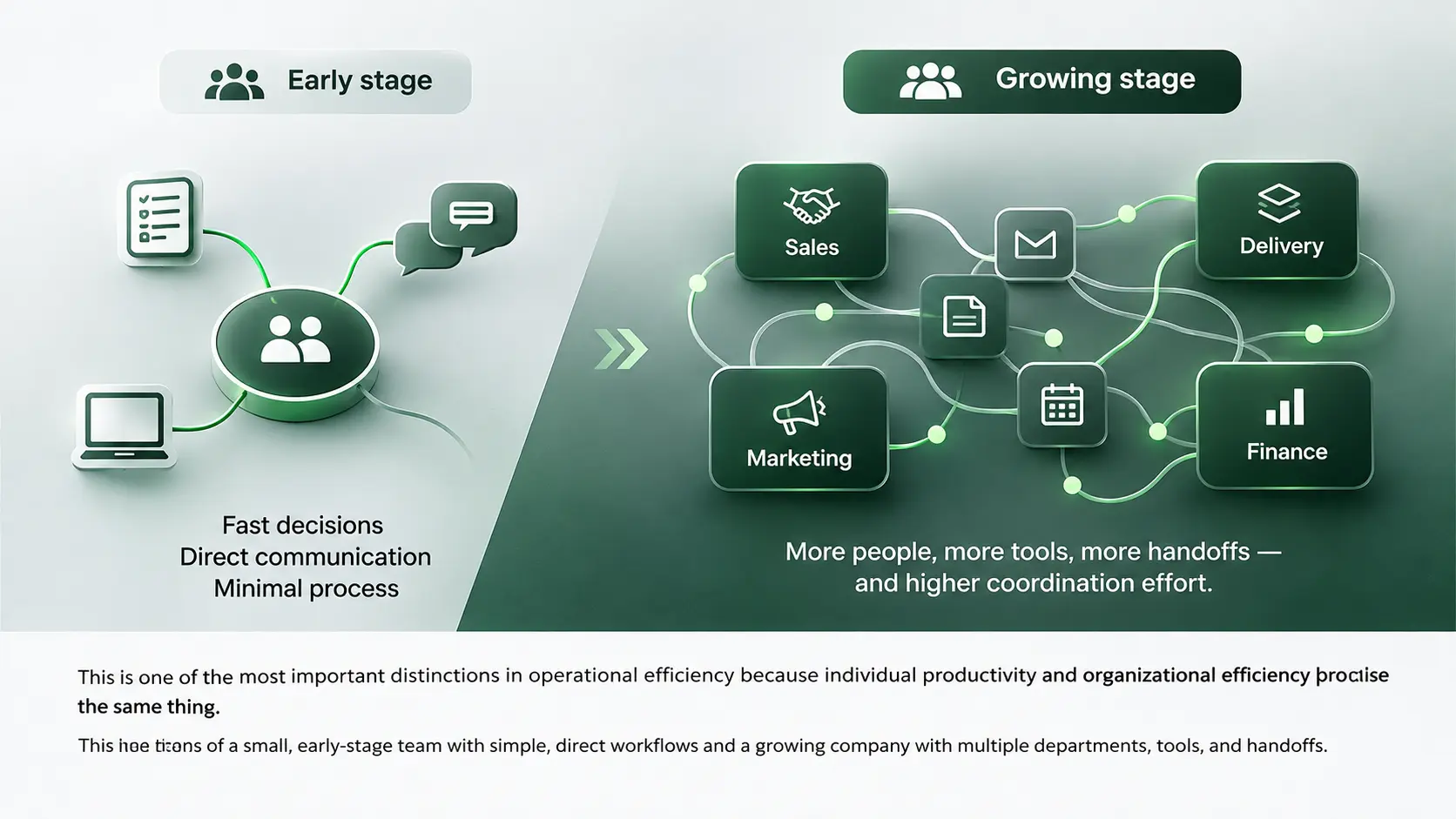
The work itself may not have become dramatically more complicated, but the number of relationships surrounding the work has increased. Information needs to cross organizational boundaries, decisions need to reach more people, and responsibilities that once felt obvious become increasingly ambiguous.
This is one reason McKinsey's research into operating models emphasizes end-to-end processes rather than organizational structure alone. McKinsey notes that organizations can change reporting lines while leaving the underlying processes and behaviors largely untouched, which means that the same inefficiencies survive inside a different organizational chart.
For a growing business, this distinction matters enormously. Hiring more people into an inefficient workflow increases capacity in parts of the system, but it does not necessarily make the complete system work better.
Sometimes it simply gives the company more people who need to coordinate with one another.
Operational Inefficiency Often Looks Like Productivity
One reason operational problems survive for so long is that they rarely look like inactivity.
They look like work.
A project manager spends two hours assembling information from different systems before a stakeholder meeting. A sales manager reviews a spreadsheet because the CRM does not provide a trusted view of the pipeline. A delivery manager asks several people for updates because project status is inconsistent. Someone copies customer information from an email into another application because the systems are not connected.
Every person involved is genuinely working.
The problem is that a meaningful portion of that work exists only because the operating system around them creates friction.
This distinction changes the questions a company should ask when investigating efficiency.
Instead of asking why somebody needs twenty minutes to complete a task, it can be much more useful to ask what needs to happen before that person can begin the task, what information they need, where that information comes from, what happens after they finish, and how long the work waits between those points.
The difference between active work and elapsed time is particularly important. APQC's guidance on cycle time defines cycle time as the complete elapsed period from the beginning of a process to its end, including both active work and the time spent waiting for the process to move forward.
That means a task that requires thirty minutes of actual effort can still belong to a process that takes three days.
If the company concentrates only on making those thirty minutes faster, it may completely miss the real problem.
Follow the Work From Beginning to End
A useful way to understand operational efficiency is to stop looking at departments for a moment and follow a real piece of work through the company.
Imagine a potential customer completing a contact form.
The website sends an email to a shared inbox. Someone reads it and forwards it to sales. Sales creates a CRM record and contacts the prospect. Eventually a deal is agreed, but the information collected during the sales process is not structured in the same way that delivery needs it.
The project manager therefore schedules another conversation to reconstruct the requirements. Information is then copied into the project management system, somebody creates the project documentation, finance needs separate commercial information, and several people need to be notified that work is beginning.
Each individual step may appear small.
Taken together, however, they form the real operational cost of acquiring and onboarding a client.
Now imagine redesigning the same process from the perspective of the complete outcome rather than individual departments. The original inquiry creates a structured CRM record. Qualification information is captured in a form that can later be used by delivery. When the opportunity reaches the appropriate stage, the relevant people are notified and the next workflow begins with the information already available.
The goal is not necessarily to automate everything.
The goal is to stop forcing the organization to reconstruct context every time responsibility moves from one part of the business to another.
This end-to-end perspective is also central to McKinsey's approach to process improvement. Its framework describes improving work by eliminating unnecessary activities, synchronizing related work, streamlining the remaining workflow, and only then introducing automation where it provides useful leverage.
The order matters because many operational problems disappear before automation is required.
Is growth making your operations harder to manage?
Identify the bottlenecks and complexity slowing your operations down.
Handoffs Quietly Consume Time
Every handoff introduces a small operational tax.
When work moves between two people, teams, or systems, the recipient needs enough context to understand what has happened, what is expected next, and what decisions have already been made. If that context is incomplete, another conversation begins.
One handoff may cost only a few minutes.
Dozens of handoffs across hundreds of recurring processes create something very different.
Consider a customer issue that begins with support, moves to an account manager, then to a project manager, then to a technical specialist, and eventually travels back through part of the same chain before the customer receives an answer.
Nobody involved needs to be particularly slow for the customer experience to become slow.
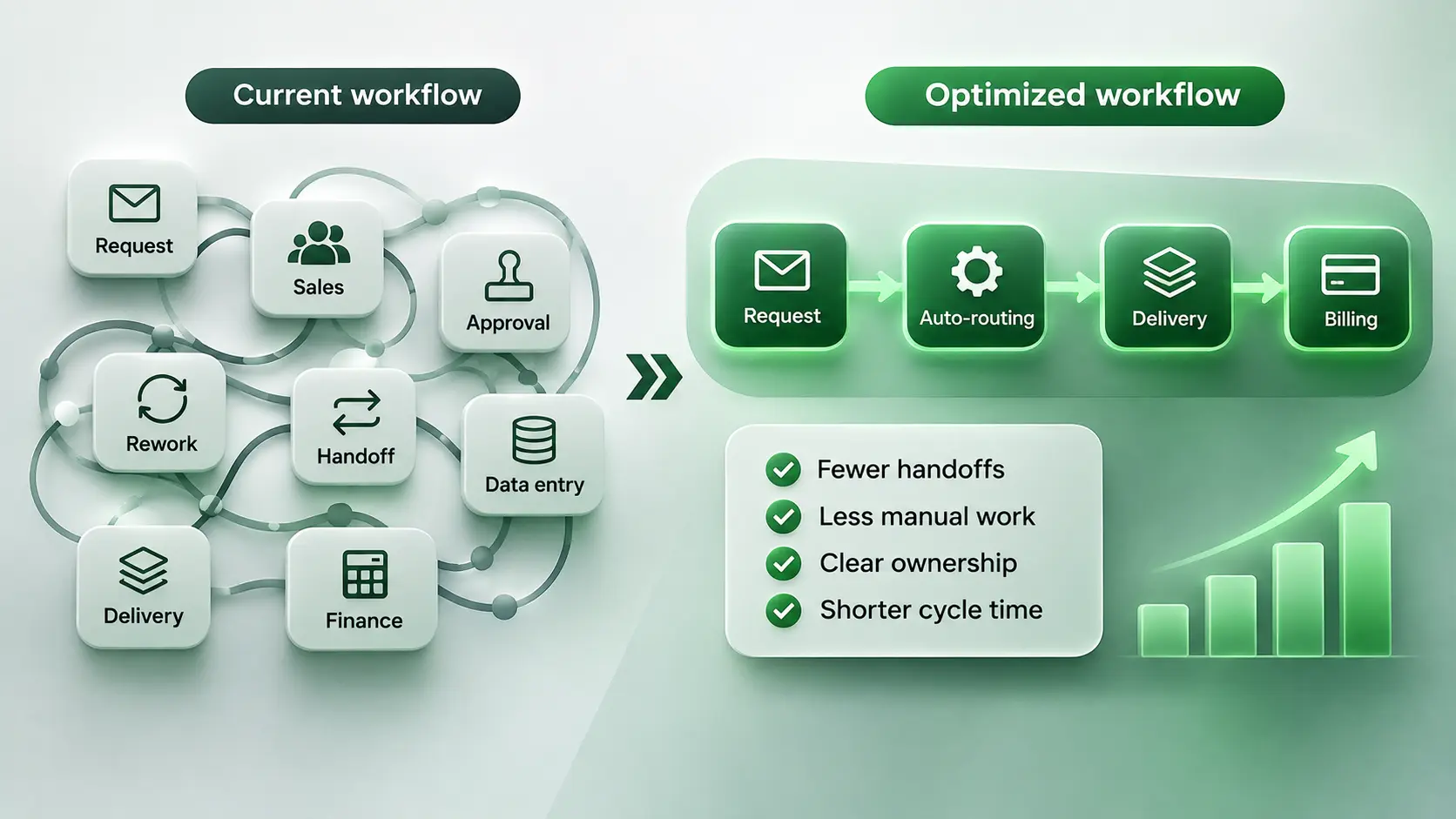
Most of the elapsed time may consist of the issue waiting for the next person to notice it.
This is why operational analysis should pay attention to waiting time and handoff time rather than measuring only the time people actively spend performing tasks. APQC specifically includes wait time, handoff time, processing time, rework, and exception resolution when discussing workflow performance.
Once a company begins seeing work in this way, many familiar problems look different.
A slow process may not need faster employees. It may need fewer transitions.
Unclear Ownership Creates More Coordination
Another pattern becomes increasingly expensive as organizations grow: many people can be involved in a process while nobody clearly owns its outcome.
In a small company, founders frequently compensate for this ambiguity without realizing it. When something is delayed, they notice. When a customer has not received an answer, they intervene. When two teams disagree about responsibility, they make the decision.
As the company grows, this informal safety net becomes impossible to maintain.
Recurring workflows need a clear understanding of who is responsible for ensuring that an outcome actually happens. This does not mean one person must perform every task. A process can involve several specialists while still having a clear owner who understands its state and has enough authority to move it forward.
Without that ownership, operational problems begin circulating through the organization.
A delayed project becomes something "the team is discussing." A customer problem becomes something "support is checking." An internal improvement becomes something everyone agrees should happen when there is time.
The company responds by adding communication.
More people are copied into messages. More status meetings appear. More approvals are requested because nobody is certain who can decide.
The result is paradoxical: the organization creates more coordination to compensate for the absence of clear responsibility, and the additional coordination makes the organization even harder to navigate.
Good operations reduce the need for this kind of communication by making responsibility and decision boundaries explicit.
Standardization Should Remove Repeated Decisions
Standardization has an unfortunate reputation because poorly designed standard processes can become bureaucratic very quickly.
A useful standard, however, does not exist to prevent people from thinking. It exists to prevent them from having to solve the same routine problem repeatedly.
Consider client onboarding.
If every new client requires somebody to remember which information needs to be collected, where documents should be stored, who needs access, when finance should be notified, which meetings should be scheduled, and what the client should receive, the company is relying on individual memory for a process that happens repeatedly.
As volume increases, variation becomes inevitable.
One project starts with all the required information. Another begins without important commercial context. Someone forgets to notify finance. A client waits for access because nobody realized that provisioning was still incomplete.
Scoro's guidance on operational efficiency identifies recurring workflows such as client onboarding, invoicing, and project kickoff as particularly suitable for standardization because inconsistent execution produces delays, confusion, and quality problems as service organizations scale.
A useful standardized workflow should therefore make the normal path predictable while leaving room for genuine exceptions.
The objective is not to document every imaginable situation.
It is to stop treating routine work as if the organization has never encountered it before.
Automation Should Come After Simplification
When companies recognize operational inefficiency, automation is often one of the first proposed solutions.
The attraction is obvious. If employees repeatedly perform the same manual task, software can potentially perform it faster and more consistently.
The problem is that technology does not automatically know whether the task should exist.
IBM makes this distinction explicitly in its recent guidance on workflow automation. Before automating a process, organizations should determine whether the work itself is necessary, what outcome it supports, and why the current workflow is harder than it needs to be. The recommendation is to redesign the workflow before using automation to accelerate it.
Imagine a company where website inquiries arrive by email, somebody copies them into a spreadsheet, a manager reviews the spreadsheet, and approved leads are then entered into a CRM.
All of those movements can be automated.
The better question is whether the spreadsheet should exist at all.
If the CRM can already store the information, apply qualification rules, assign ownership, and trigger notifications, the redesigned workflow might move directly from the website into the CRM.
An entire stage disappears.
This is the difference between automating tasks and improving operations.
The same principle applies to AI. Adding an intelligent assistant to a process that contains unnecessary approvals, duplicated information, and unclear ownership does not remove those problems. It may simply make an unnecessarily complicated workflow operate faster.
Technology creates the most value after the company understands what the workflow is supposed to accomplish.
Before you automate, understand what should actually change
Simplify workflows and clarify ownership before adding automation.
Integrations Can Remove Invisible Manual Work
A large amount of operational work exists because information is available somewhere, but not where the next person needs it.
Sales knows why a customer purchased, but delivery cannot see the context. A project reaches a billing milestone, but finance has to ask whether an invoice can be issued. A customer submits information through a website, but somebody needs to transfer it manually into a CRM. Support has a complete history of a problem, while the project team sees only the latest message.
Employees gradually become the integration layer between systems.
They copy, paste, reformat, forward, reconcile, and explain.
This work can feel too small to justify attention because each individual action takes only a few minutes. Across a growing organization, however, those minutes accumulate while also creating opportunities for missing or inconsistent information.
The objective of integration should therefore be practical rather than architectural.
A company does not need every tool connected to every other tool. It needs important information to follow the workflow.
A contact form can create or update a CRM record. A CRM stage change can notify the person responsible for the next action. A completed delivery milestone can provide finance with the information required for billing. A support escalation can include enough customer and project context for the receiving team to act without reconstructing the situation.
This is also why we approach Business Operations at PQOnix as a combination of process, ownership, information flow, and technology rather than treating automation as an isolated service.
The integration is valuable because of the operational problem it removes.
More Software Does Not Automatically Create Better Operations
When operational visibility is poor, companies frequently respond by adding another tool.
A dashboard appears because management cannot see performance. Another project management platform appears because tasks are difficult to coordinate. A new communication channel is created for a particular workflow. A spreadsheet remains because somebody does not trust the data in the main system.
Eventually the company has more software and less certainty about where the truth lives.
This problem is especially common when tools are selected independently by different functions. Each team optimizes its own environment while the connections between those environments remain informal.
The organization then develops several versions of the same reality.
The CRM says one thing about a customer, the project management platform says another, and a spreadsheet contains the version used for the management meeting.
At that point, improving operational efficiency requires more than introducing another application. The company needs to decide which systems are authoritative for which types of information and what events should cause information to move between them.
Where does customer information live?
Where is project status maintained?
Which system represents the commercial state of an opportunity?
Where are important operational decisions recorded?
Once these boundaries are understood, integrations become easier to design and reporting becomes more reliable because the organization is no longer constantly reconciling competing sources of truth.
Metrics Need to Explain Performance
Operational improvement often creates a new enthusiasm for dashboards, but a dashboard containing twenty numbers is not necessarily providing twenty useful insights.
Activity is particularly easy to measure.
A company can count completed tasks, support tickets, meetings, project hours, leads, messages, or releases. Those numbers can be accurate while still providing very little information about whether the underlying process works well.
APQC's current guidance on process performance recommends balancing measures across cost effectiveness, staff productivity, process efficiency, and cycle time, with the specific metrics chosen according to the purpose and strategic importance of the process. APQC also recommends keeping the measurement set focused rather than allowing dashboards to expand indefinitely.
This approach is useful because operational metrics should help explain an outcome.
If customer onboarding is taking longer, total cycle time may reveal the problem, while supporting measures can show whether the increase comes from waiting, rework, missing information, system downtime, or capacity.
If projects repeatedly miss deadlines, counting completed tasks may be considerably less useful than understanding decision latency, dependency delays, scope changes, and rework.
The purpose of measurement is not to prove that people are active.
It is to make the behavior of the operating system visible.
Capacity Is Not Always a Headcount Problem
Eventually, growing companies encounter a familiar symptom: work begins accumulating faster than it is completed.
The obvious conclusion is that the team needs more people.
Sometimes that conclusion is correct.
Sometimes the constraint is somewhere else entirely.
Imagine a team where every significant decision requires approval from one manager. Adding three more specialists gives the company additional production capacity while creating even more work waiting for the same decision maker.
Imagine an onboarding team that spends much of its time requesting information that should have been collected during sales. Another onboarding specialist can process more cases, but the missing information remains the constraint.
Imagine project managers spending several hours each week manually assembling status reports because the company's systems do not provide a reliable view of delivery. Hiring another project manager increases the organization's capacity to assemble reports without addressing why those reports require manual assembly.
Operational efficiency therefore requires distinguishing between workload and constraint.
A team may genuinely need more capacity, but adding capacity to the wrong part of the workflow can make the organization more expensive without making it meaningfully faster.
Before hiring to solve an operational problem, it is worth understanding where the work actually waits.
Efficiency Cannot Be Separated From Quality
There is a version of operational efficiency that looks extremely attractive in a spreadsheet.
Reduce review time. Increase utilization. Remove spare capacity. Shorten every deadline. Ask every employee to handle more work.
Costs fall and output initially appears to rise.
The problem is that a process can become faster while the business outcome becomes worse.
A faster onboarding workflow that produces confused customers is not more efficient. Reducing quality assurance effort may shorten a release cycle while creating significantly more expensive rework after release. Maximizing employee utilization can increase short-term output while leaving the organization unable to absorb unexpected work.
This is why efficiency should be evaluated together with quality, cost, speed, and the outcome the process exists to create.
The same logic applies to technology projects. At PQOnix, our work across Quality Assurance, Project and Delivery Management, and Business Operations repeatedly intersects because problems in one area often appear as symptoms in another.
A recurring production defect may look like a testing problem while originating in unclear requirements.
A delayed project may look like a delivery problem while originating in slow decision making.
An overloaded operations team may appear to need more people while much of its workload consists of avoidable manual coordination.
Looking at the complete system makes these relationships much easier to see.
Operational Improvement Begins With Understanding the Current System
When a company knows that its operations are becoming inefficient, jumping directly to a solution is tempting.
Perhaps the business needs a new CRM, another operations specialist, an AI assistant, better dashboards, additional automation, or a different project management platform.
Any of those could eventually be appropriate.
Choosing them before understanding the existing workflow, however, means prescribing a treatment before identifying the cause.
An operational assessment should begin with how recurring work actually happens rather than how documentation says it happens. That means following important workflows across teams, observing where information enters and leaves the process, understanding who makes decisions, identifying repeated manual work, examining where ownership becomes ambiguous, and finding points where work repeatedly waits or returns for correction.
The objective is not to create an enormous map of every activity in the company.
It is to identify the relatively small number of constraints responsible for a disproportionate amount of friction.
One organization may discover that its apparent automation problem is actually an ownership problem. Another may discover that employees repeatedly enter the same information into several systems. Another may find that delivery delays begin before projects start because sales information does not arrive in a usable form.
The visible symptom may be similar.
The intervention can be completely different.
Improve the Workflow Before Expanding the Technology
Once the current process is understood, improvement becomes much more deliberate.
The company can examine whether every stage contributes to the intended outcome, whether activities can be removed, whether related work should happen together, whether handoffs can be reduced, whether decision rights are clear, and whether recurring work can be standardized.
Only after those questions are answered does automation become particularly powerful.
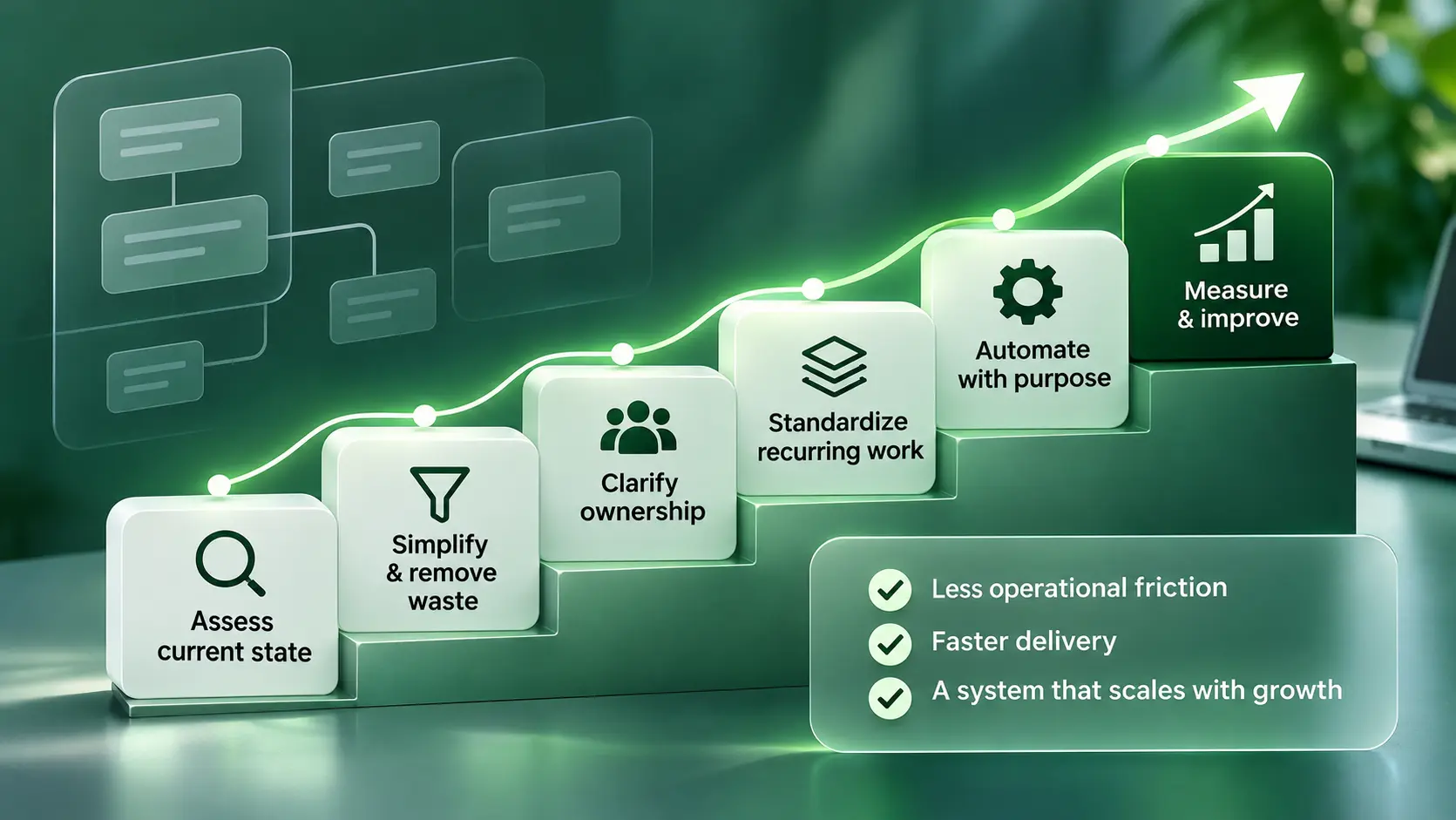
This sequence aligns closely with McKinsey's end-to-end approach of eliminating, synchronizing, streamlining, and then automating work. It also aligns with IBM's recommendation to redesign the workflow before deploying automation or AI on top of it.
The distinction may sound subtle, but it has significant practical consequences.
If the company starts with technology, it asks what the software can automate.
If the company starts with the process, it asks what the business actually needs to happen.
The second question usually produces a simpler system.
Good Operations Become Almost Invisible
One of the clearest signs of an effective operating system is that employees do not need to think about it constantly.
A new customer reaches the appropriate owner with the required context. A project begins with the information delivery needs. A manager can understand status without organizing a meeting purely to reconstruct it. An employee knows which system contains authoritative information. A recurring workflow follows a predictable path, while genuine exceptions are easy to identify.
When an important event occurs, the next action happens because the process was designed to make it happen rather than because somebody happened to remember.
None of these improvements sounds revolutionary.
Together, however, they change the amount of cognitive and administrative effort required to run the company.
People spend less time maintaining the machinery around their work and more time doing the work itself.
That is the practical meaning of operational efficiency.
Build operations that can keep up with your growth
Build clearer, more efficient operations that scale with your business.
The Real Goal Is to Make Growth Easier to Absorb
No operating model remains optimal forever.
A process that works extremely well for ten people can become inadequate at fifty. A CRM configuration that fits one sales motion may become restrictive when the company enters another market. A simple approval model may become a bottleneck when decision volume increases.
Operational efficiency is therefore not about creating a perfect system and freezing it.
It is about creating a company that can recognize when its current system no longer fits.
Processes should be structured enough to repeat without requiring constant reinvention, while remaining flexible enough to change when the business changes. Ownership should be clear enough that decisions can move. Information should follow the work rather than depend on employees manually carrying it between systems. Metrics should reveal where performance is changing before the consequences become severe.
Most importantly, operational problems should become visible before the company learns to treat them as normal.
When everyone is working hard but routine work keeps becoming slower, the solution is not necessarily more effort.
Sometimes the most valuable thing a company can do is examine the system through which all of that effort has to travel.
PQOnix Business Operations helps technology companies examine workflows, responsibilities, information flows, tools, and operational bottlenecks, then turn those findings into practical improvements that fit the way the business actually works.
If growth is beginning to create more coordination than progress, start a conversation with PQOnix.