



Software teams rarely wake up one morning with a completely broken quality process. Problems always accumulate gradually.
Regression testing takes longer. Requirements become less precise. Production defects increase. Releases require more manual coordination. Test documentation stops reflecting the actual product. QA becomes involved too late. Nobody is entirely sure who can approve a release or which risks are acceptable.
Each problem may appear manageable in isolation. Together, they can indicate that the quality assurance system no longer matches the product, team, or release process it is supposed to support.
A QA audit is designed to make that situation visible.
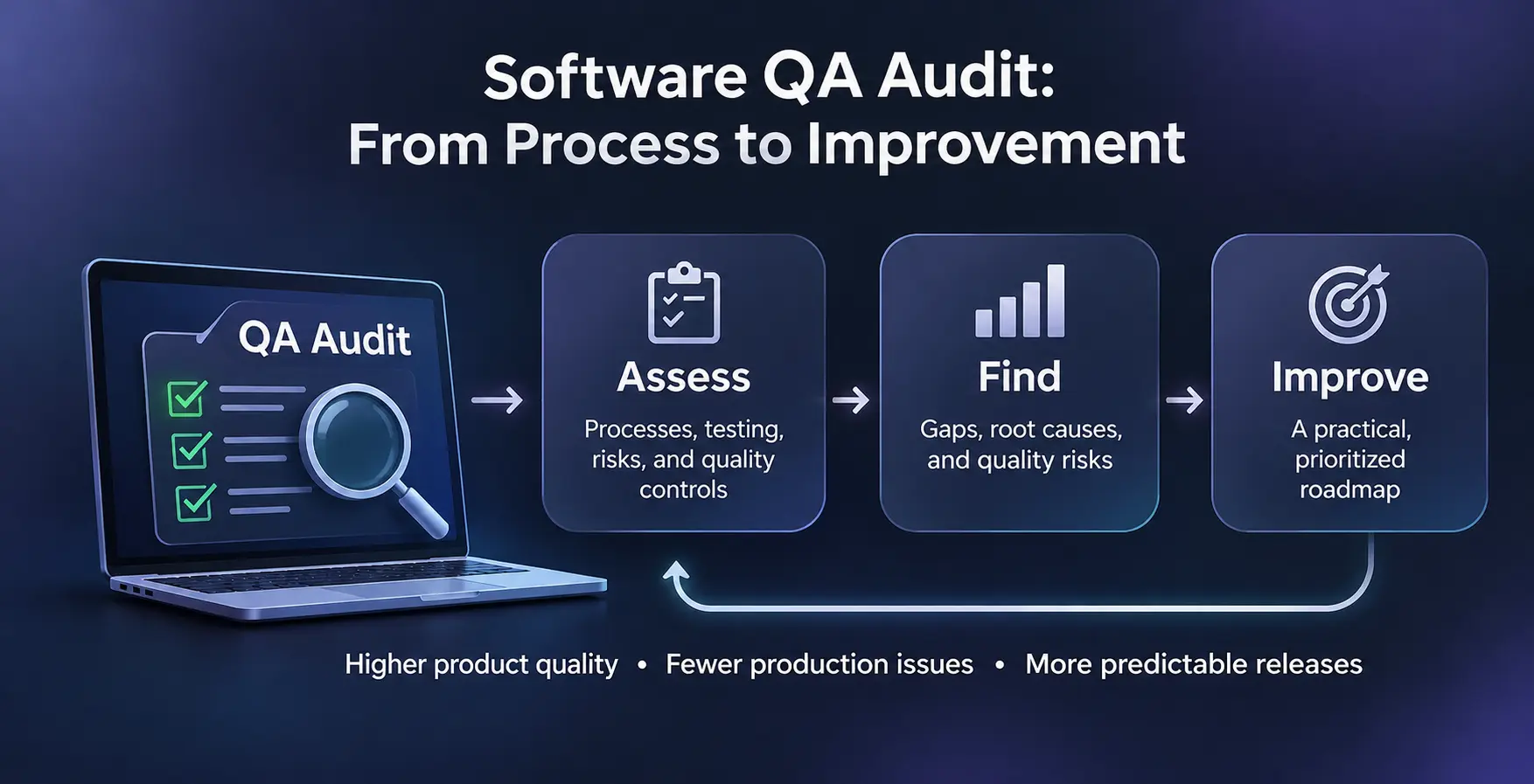
Rather than simply testing the application for bugs, an audit examines the system behind software quality: how requirements become testable conditions, how risks influence testing priorities, how defects are managed, how release decisions are made, and whether the available evidence actually supports confidence in product quality.
This distinction matters. The ISTQB definition of quality assurance describes QA as activities focused on providing confidence that quality requirements will be fulfilled. A QA audit asks whether the processes intended to provide that confidence are actually capable of doing so.
For software organizations, this makes QA auditing less about finding individual defects and more about understanding why quality problems occur, where controls are weak, and what should change.
What Is a QA Audit?
A QA audit is a systematic and objective examination of quality-related processes, practices, documentation, responsibilities, and evidence.
The broader concept of a quality audit is commonly defined as a systematic examination of a quality system performed by internal or external auditors. Quality audit overview
ISO takes a similarly structured approach. The current ISO 19011:2026 standard provides guidance for auditing management systems, including audit principles, audit program management, audit execution, and auditor competence.
In software development, however, a QA audit needs to translate those principles into the reality of product delivery.
That means examining questions such as:
Are requirements clear enough to test?
Is testing prioritized according to product and business risk?
Are critical user journeys adequately covered?
Does regression testing reflect the current product?
Are defects consistently classified and tracked?
Are recurring production issues analyzed?
Are test environments and data suitable for meaningful testing?
Are release criteria defined?
Is QA involved at the right stages of delivery?
Can stakeholders understand the actual quality risk before releasing?
The objective is not simply to determine whether a QA team follows a documented procedure. It is to determine whether the overall quality process is effective.
That distinction between compliance and effectiveness is important. Modern quality auditing increasingly evaluates whether processes achieve their intended outcomes, rather than only whether procedures exist.
QA Audit vs Software Testing
A QA audit and software testing are related, but they answer different questions.
Software testing asks:
Does the product behave as expected?
A QA audit asks:
Does the organization have an effective system for determining whether the product behaves as expected and whether it is safe to release?
A tester might identify a checkout defect.
An auditor goes further:
Why was the scenario not covered before release? Was it missing from the requirements? Was the regression suite outdated? Was the integration considered low risk? Was testing shortened because of release pressure? Was the defect known but incorrectly prioritized? Is the same failure pattern appearing elsewhere?
This is why simply increasing the amount of testing does not necessarily solve systemic quality problems.
If the underlying process is weak, more test execution can produce more activity without producing proportionally more confidence.
A QA audit therefore evaluates the system around testing, not only test execution itself.
For organizations that need broader QA support rather than a one-time assessment, PQOnix provides Quality Assurance consulting focused on building practical quality processes around the actual product and delivery environment.
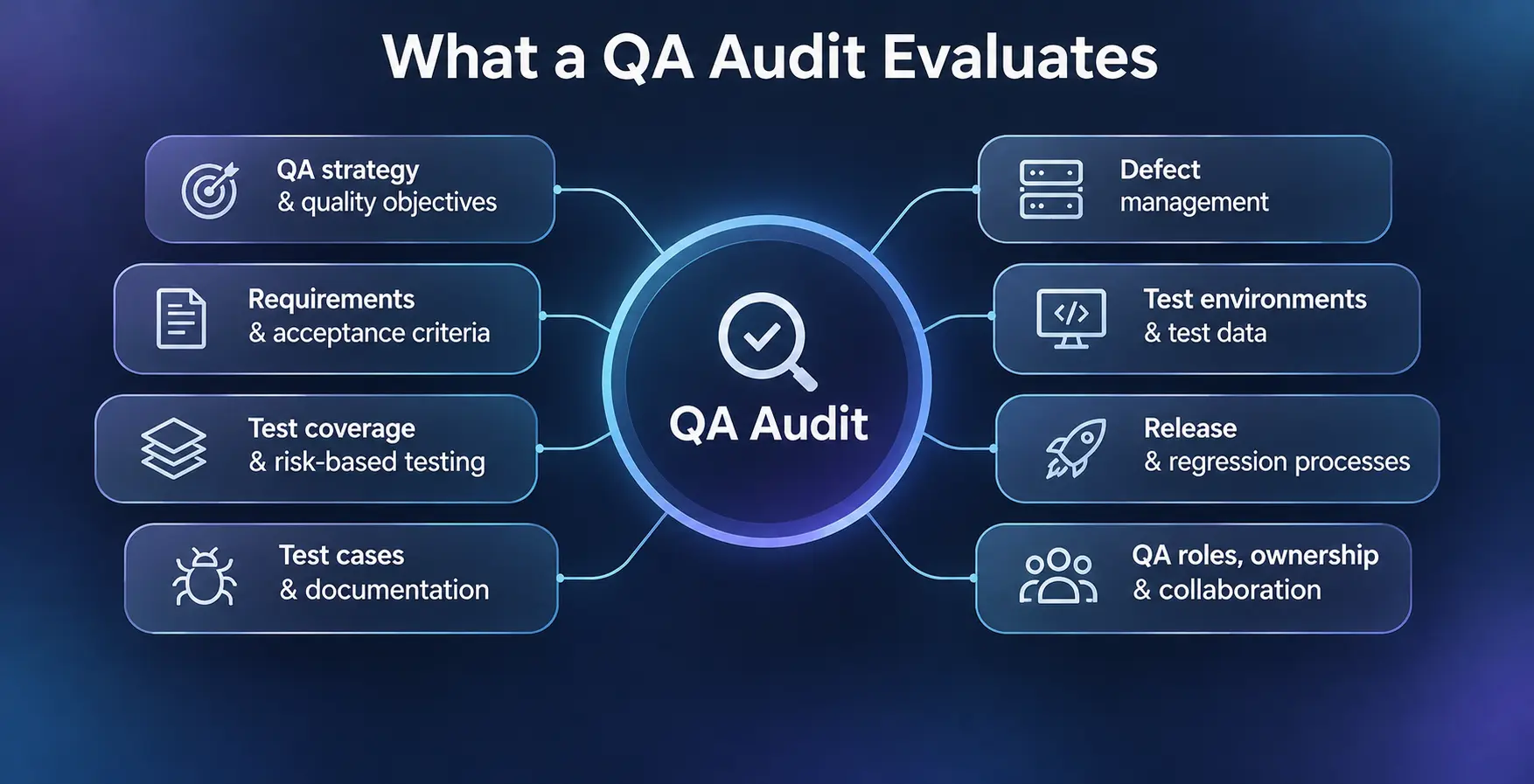
What Does a Software QA Audit Evaluate?
The exact scope depends on the product, organization, maturity level, industry, and reason for the audit. A useful assessment normally covers several connected areas.
1. QA Strategy and Quality Objectives
An auditor first needs to understand what "quality" means for the product.
A fintech platform, healthcare application, internal business tool, marketplace, and marketing website do not carry the same risks. Their QA strategies should not be identical.
The audit examines whether the team has consciously identified:
critical product risks;
critical user journeys;
quality objectives;
appropriate testing levels;
responsibilities;
entry and exit criteria;
release expectations.
The goal is not necessarily to find a large formal test strategy document. Smaller organizations may not need one.
The important question is whether there is a coherent strategy behind QA decisions.
2. Requirements and Acceptance Criteria
Testing quality is constrained by requirement quality.
If requirements are ambiguous, incomplete, constantly changing, or impossible to verify objectively, QA will struggle regardless of tester experience.
An audit therefore examines how requirements move from business intent to development and testing.
Typical questions include:
Are acceptance criteria testable?
Are expected behaviors clearly defined?
Are negative scenarios considered?
Are edge cases discussed before implementation?
Are requirement changes communicated to QA?
Is there traceability between requirements and testing?
Can QA challenge unclear requirements?
This area often reveals that a perceived "testing problem" actually begins much earlier in the delivery lifecycle.
3. Test Coverage and Risk-Based Testing
A large number of test cases does not automatically mean good coverage.
An audit examines whether testing reflects actual product risk.
Critical workflows such as authentication, payments, permissions, data modification, integrations, or core revenue-generating functionality generally deserve more attention than low-impact functionality.
The current ISO/IEC 25010:2023 product quality model provides a useful reference framework for evaluating software and ICT product quality. It defines nine product quality characteristics and explicitly supports activities such as defining testing objectives, quality control criteria, acceptance criteria, and product evaluation.
An audit may therefore consider not only functional behavior but also relevant quality characteristics such as reliability, performance efficiency, security, interaction capability, compatibility, maintainability, flexibility, and safety.
The point is not to test every possible characteristic equally.
The point is to determine whether important risks have been identified and whether the testing strategy addresses them.
4. Test Cases and Test Documentation
Test documentation should help the team control quality, not exist merely because "QA needs documentation."
An audit may examine:
test case structure;
regression suites;
smoke testing;
checklists;
exploratory testing practices;
test execution records;
traceability;
outdated or duplicated cases;
maintenance practices.
A common problem is documentation that once represented the product accurately but has gradually become disconnected from it. Another is the opposite: almost no persistent testing knowledge exists, so critical regression knowledge remains inside individual team members' heads. Neither extreme is healthy.
The appropriate level of documentation depends on the product, team, risk profile, and release frequency.
5. Defect Management
Defect tracking provides valuable evidence about the health of both the product and the QA process.
An audit looks beyond the number of open bugs.
It may examine:
severity and priority definitions;
defect reporting quality;
triage practices;
reopened defects;
recurring defects;
defect leakage into production;
root causes;
resolution times;
ownership;
patterns across releases.
Repeated production defects of the same type can indicate a systemic gap rather than isolated mistakes.
For example, recurring permission issues may indicate insufficient role-based regression coverage. Repeated integration failures may indicate weak integration testing or unstable test environments. Frequent misunderstandings around expected behavior may point back to requirements.
The purpose of defect analysis is therefore not to assign blame. It is to find patterns.
6. Test Environments and Test Data
Testing results are only meaningful if the environment and data allow realistic behavior to be evaluated.
An audit may assess:
differences between test and production environments;
environment stability;
configuration management;
access and permissions;
third-party integrations;
test account availability;
test data quality;
dependencies on developers or other teams;
data privacy considerations.
A QA team may have strong test cases and still miss serious problems if the environment does not reproduce important production conditions.
7. Release and Regression Processes
Release pressure exposes weaknesses in QA systems quickly.
A QA audit examines what happens when a release approaches:
What must be tested?
What can be skipped?
Who makes that decision?
What happens when critical defects remain?
Are known risks documented?
Who approves release readiness?
Is regression testing predictable?
Are results visible to stakeholders?
Is there a rollback or mitigation strategy when relevant?
If every release depends on last-minute negotiations and individual judgment, the process may technically work while remaining operationally fragile.
8. QA Roles, Ownership and Collaboration
Quality is not solely the responsibility of testers.
A mature QA process requires interaction between product, development, QA, delivery, and business stakeholders.
The audit therefore evaluates whether responsibilities are clear.
Common issues include:
QA joining too late;
unclear ownership of acceptance criteria;
developers and QA working sequentially rather than collaboratively;
QA becoming the final approval bottleneck;
business risks not reaching the QA team;
no clear ownership of production quality;
testers being expected to compensate for incomplete requirements.
A strong quality system makes ownership explicit instead of treating QA as the department that "catches bugs before release."
9. QA Metrics and Reporting
Metrics should help teams make decisions.
A large dashboard is not necessarily evidence of a mature QA process.
The audit asks whether available metrics answer useful questions such as:
Where are defects escaping?
Which product areas generate recurring issues?
Is regression becoming harder to complete?
Are critical defects discovered early or late?
Are production incidents repeating?
Is quality improving between releases?
Metrics without context can be misleading. Test case counts, bug counts, or pass rates can look impressive while saying little about actual product risk.
Useful QA reporting connects evidence to decisions.
Not sure whether your current QA process is actually working?
PQOnix can independently assess your QA process, identify quality risks, and show where testing, ownership, documentation, or release practices need improvement.
When Does a Company Need a QA Audit?
A QA audit can be useful at any stage, but several situations are particularly strong signals.
Production Defects Are Increasing
An occasional production defect does not necessarily indicate a broken QA process.
A pattern does.
If customers repeatedly discover issues that internal testing should reasonably have detected, the organization needs to understand why defects are escaping.
Releases Are Becoming Harder to Predict
QA may become a bottleneck when testing scope grows faster than the process supporting it.
Symptoms include regression taking progressively longer, testing beginning late, unclear release criteria, and repeated last-minute scope reductions.
The audit helps distinguish a capacity problem from a process problem.
The Product Has Grown but QA Has Not
Processes that worked for a small MVP may become ineffective as the product gains more integrations, roles, platforms, customers, and dependencies.
QA maturity needs to evolve with product complexity.
The Team Is Scaling
Adding testers without first understanding the existing process can scale inefficiency.
An audit before or during team growth can clarify roles, processes, documentation requirements, priorities, and gaps.
The Company Has No Dedicated QA Leadership
Some teams have capable testers but no senior QA function responsible for strategy, process design, metrics, or continuous improvement.
An independent assessment can provide the strategic view that is missing from day-to-day execution.
A Major Release or Product Change Is Approaching
A migration, redesign, new platform, critical integration, market expansion, or architectural change can alter the product's risk profile.
An audit can determine whether the existing QA approach is still appropriate before those risks reach production.
Stakeholders Have Lost Confidence in Quality
Sometimes the strongest signal is not a metric.
It is behavior.
Product managers repeatedly ask for additional testing. Developers distrust regression results. Releases are delayed "just to be safe." Management cannot get a clear answer about release risk.
When confidence becomes subjective, an evidence-based assessment can establish a shared view of the situation.
Internal vs External QA Audit
Quality audits are commonly divided according to who performs them.
An internal audit is performed by the organization itself. An external audit involves an independent party. In broader quality management practice, external audits can also include second-party and third-party audits. Scilife's overview of quality audit types
For software teams, the distinction has practical consequences.
Internal QA Audit
An internal audit can work well when the organization has sufficient QA expertise and the auditor can evaluate the process objectively. Advantages include:
strong product context;
easier access to evidence;
lower coordination overhead;
ability to perform assessments regularly.
The main risk is familiarity. People who designed or operate a process may unconsciously accept its assumptions.
External QA Audit
An external auditor brings independence and comparison with practices outside the organization.
This is particularly useful when:
internal teams disagree about the problem;
QA leadership is absent;
management needs an independent assessment;
the organization is restructuring QA;
recurring issues have resisted internal improvements;
the company wants to establish a baseline before scaling.
Independence is one of the reasons auditing should not be confused with ordinary operational QA work.
How Does a QA Audit Work?
The exact methodology should adapt to the organization, but a practical software QA audit normally follows a structured sequence.
Step 1: Define the Audit Objective and Scope
The audit should begin with a problem, not a generic checklist.
For example:
"Why are critical defects reaching production?"
is a better starting point than:
"Audit our QA."
The scope may include the complete QA system or a particular area such as regression, requirements, release management, defect leakage, documentation, or a specific product.
Step 2: Understand the Product and Delivery Context
Before evaluating QA, the auditor needs to understand:
the product;
business-critical workflows;
users;
architecture at a relevant level;
team structure;
release cadence;
delivery process;
known quality problems;
business constraints.
Without context, an auditor risks recommending theoretically correct practices that do not solve the organization's actual problem.
This is also why a structured discovery process matters before proposing changes. Our guide to discovery calls in IT consulting explains how context, symptoms, constraints, and business impact should be established before a solution is prescribed.
Step 3: Review Existing Evidence
Evidence may include:
QA strategy;
test plans;
test cases and checklists;
requirements and acceptance criteria;
defect history;
production incidents;
release records;
test reports;
QA metrics;
process documentation;
project management boards;
relevant environment information.
The objective is not to reward teams for having more documents.
The auditor needs to compare documented processes with actual behavior.
That evidence-based principle is central to quality auditing more broadly. A quality audit is intended to examine objective evidence and determine whether processes are implemented and effective. Overview of quality auditing principles
Step 4: Interview Key Stakeholders
Documentation rarely tells the whole story.
QA specialists, developers, product managers, delivery managers, and other relevant stakeholders may experience the same process differently.
Interviews help reveal gaps between the official workflow and actual execution.
For example:
"The acceptance criteria are always ready before development"
may become:
"Except when a high-priority feature enters the sprint."
Those exceptions often contain the most useful audit information.
Step 5: Evaluate the QA System
The auditor compares evidence against:
business and product risks;
internal expectations;
established QA practices;
relevant standards or quality models;
the organization's actual needs.
This is where findings begin to form.
A finding should not simply say:
"Regression testing needs improvement."
It should explain what was observed, why it creates risk, what evidence supports the conclusion, and what improvement is recommended.
Step 6: Prioritize Findings by Risk and Impact
Not every problem deserves immediate action.
A useful audit separates:
critical risks;
high-priority weaknesses;
medium-term improvements;
lower-priority optimization opportunities.
Without prioritization, an audit can produce a long improvement backlog that the organization never implements.
Step 7: Build an Improvement Roadmap
The final objective is not the audit report. It is improvement.
Recommendations should therefore be realistic, sequenced, and connected to the problems they are intended to solve.
A team may not need twenty new processes. It may need three changes implemented consistently.
Production bugs are only the symptom. Find the process behind them.
A PQOnix QA audit looks beyond individual defects to evaluate the QA system around your product and identify the changes with the highest practical impact.
What Should a QA Audit Report Include?
A useful QA audit should produce something actionable, not a generic presentation of "best practices."
The final deliverables will depend on scope, but typically include the following.
Executive Summary
A concise explanation of:
the current QA state;
major risks;
strongest areas;
most important weaknesses;
recommended priorities.
Management should be able to understand the situation without reading every detailed finding.
Findings With Evidence
Each significant finding should explain:
what was observed;
what evidence supports it;
why it matters;
what risk it creates;
what should change.
Risk Prioritization
Findings should be ranked according to business and product impact rather than presented as an undifferentiated checklist.
QA Maturity Assessment
When useful, the audit can describe the maturity of different QA capabilities.
For example, requirements management may be relatively mature while regression management remains largely ad hoc.
A single overall "QA score" can hide this difference, so capability-level assessment is often more useful than one headline number.
Improvement Roadmap
Recommendations should be translated into practical next steps.
That may include:
immediate corrective actions;
short-term process changes;
documentation improvements;
ownership changes;
revised release criteria;
coverage improvements;
longer-term QA capability development.
What Are Common QA Audit Findings?
Every organization is different, but several patterns appear frequently.
QA Starts Too Late
Testing begins after development instead of quality considerations being incorporated during requirements and planning.
Acceptance Criteria Are Inconsistent
Some tickets are precise while others rely heavily on verbal clarification.
Regression Coverage Is Unclear
The team performs regression testing, but nobody can clearly explain what is covered, why it is covered, or what is intentionally excluded.
Test Documentation Is Outdated
Test cases exist, but they no longer represent the current product.
Defect Severity Is Subjective
Different team members classify similar defects differently, making prioritization and reporting unreliable.
Production Defects Are Not Feeding Back Into QA
Bugs are fixed but not analyzed for process implications.
The same category of issue can therefore escape again.
Release Decisions Depend on Individuals
There are no explicit quality gates or risk acceptance rules, so release confidence depends on who happens to be involved.
QA Metrics Measure Activity Instead of Risk
Teams report how many tests were executed or bugs were created without showing whether important product risks are becoming better controlled.
Processes Exist but Are Not Followed
Documentation describes one workflow while the team operates another.
This is a classic audit concern because a documented process has little value if it does not reflect actual execution. Broader quality auditing similarly emphasizes examining both process design and real-world implementation. Quality Assurance Auditing overview from SG Systems Global
QA Audit Checklist: Questions to Ask
A quick self-assessment cannot replace a proper audit, but it can reveal whether deeper investigation is justified.
Strategy
Can we explain our biggest product quality risks?
Does our testing effort reflect those risks?
Are QA responsibilities clearly defined?
Do we know what "release ready" means?
Requirements
Are acceptance criteria consistently testable?
Does QA participate before development is complete?
Are requirement changes communicated reliably?
Are negative and edge scenarios considered?
Coverage
Do we know which critical user journeys are covered?
Is regression scope intentional?
Are important integrations tested?
Are relevant non-functional risks considered?
Defects
Are severity and priority consistently understood?
Do we analyze production defects?
Can we identify recurring defect categories?
Are reopened defects investigated?
Environments and Data
Is the test environment sufficiently representative?
Can QA obtain the data needed for meaningful scenarios?
Are environment limitations documented?
Are third-party dependencies testable?
Releases
Are release criteria explicit?
Are unresolved risks visible to decision-makers?
Is regression completed consistently?
Is responsibility for release approval clear?
Improvement
Do production incidents change future testing?
Are QA metrics used for decisions?
Are old test assets maintained or removed?
Does the QA process evolve as the product grows?
Several "no" answers do not automatically mean the QA function is ineffective.
They indicate areas where evidence should be examined more closely.
What a QA Audit Should Not Become
A QA audit should not become an exercise in forcing every organization into the same process.
It should not reward documentation volume.
It should not assume that every team needs the same tools.
It should not evaluate testers in isolation from requirements, development, product decisions, and release pressure.
And it should not produce recommendations simply because they are considered industry best practices.
A practice is useful only when it addresses a real risk or improves the organization's ability to manage quality.
This is especially important for startups and growing product teams, where adding unnecessary process can be as damaging as having too little.
QA Audit vs QA Consulting
An audit diagnoses.
Consulting helps implement change.
A company may need only an audit when it has the internal capability to act on the findings.
In other cases, the audit is the first stage of a broader QA improvement initiative.
That may involve redesigning the QA process, defining responsibilities, improving regression strategy, restructuring test documentation, introducing useful metrics, or providing fractional QA leadership.
The important principle is that implementation should follow diagnosis.
Starting with a predefined solution before understanding the problem creates a significant risk of optimizing the wrong part of the system.
What Happens After a QA Audit?
A successful audit should change something.
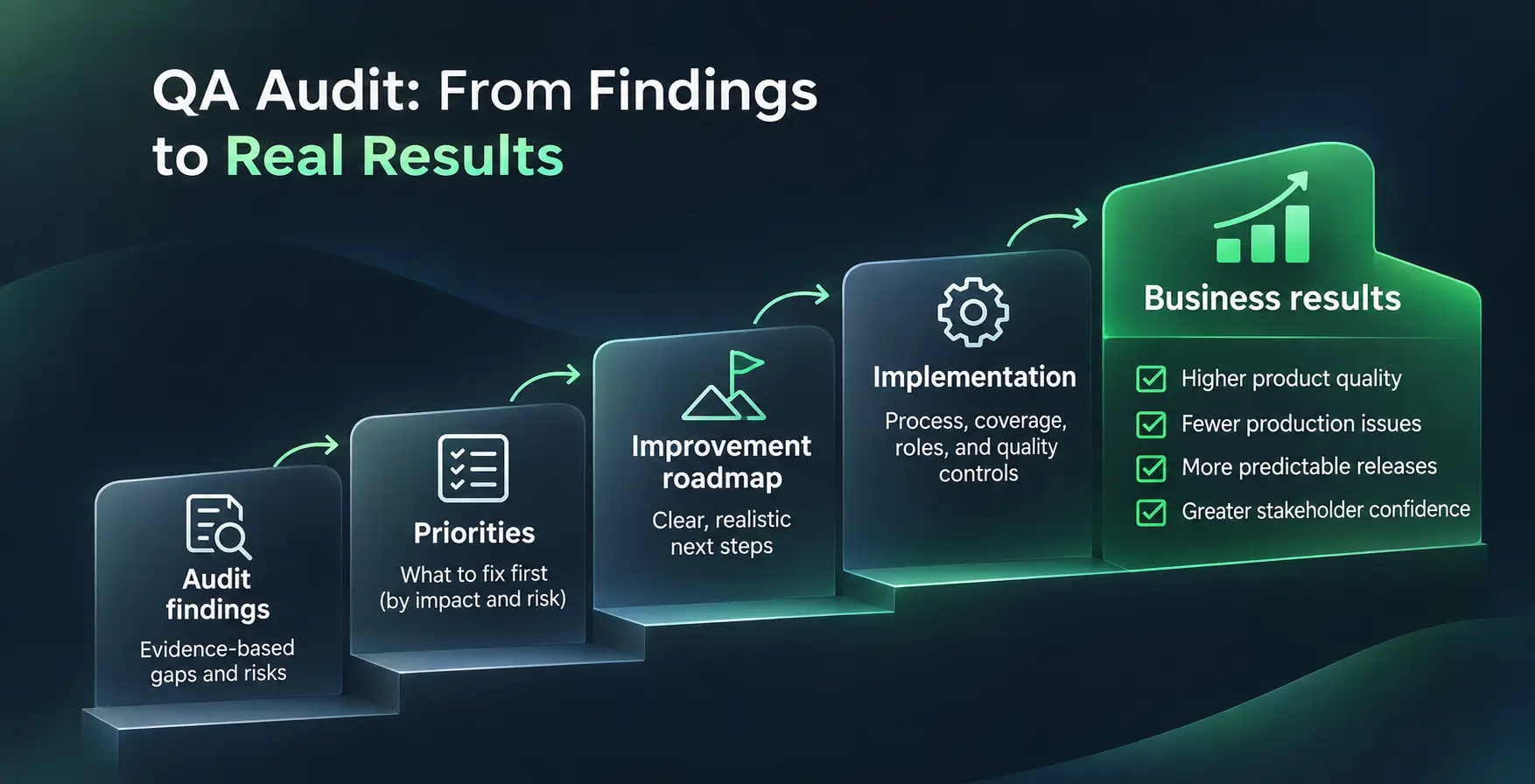
The organization should leave with a clearer understanding of:
which quality risks matter most;
why current problems occur;
which processes are effective;
which processes need redesign;
what should be changed first;
who should own those changes;
how improvement will be measured.
Some findings can be addressed immediately.
Others may require several releases or organizational changes.
The audit therefore creates a baseline rather than an endpoint.
Follow-up is important because implementing a recommendation does not automatically mean the underlying problem has been solved. The organization needs to determine whether the change actually improved outcomes.
This reflects the broader purpose of quality auditing: audits should support improvement, not simply identify nonconformities. ISO's current guidance likewise positions auditing as a mechanism for strengthening management systems and improving performance.
Final Thoughts
Software quality problems rarely come from one missing test case.
They emerge from the interaction between requirements, risk assessment, testing, communication, environments, ownership, release decisions, and feedback from production.
That is why a QA audit needs to look at the complete system.
A useful audit does not ask whether a team follows an idealized QA process. It asks whether the current process gives the organization enough reliable evidence to understand product quality and make responsible release decisions.
The result should not be more process for the sake of process.
It should be clearer risks, better decisions, stronger quality controls, and a practical roadmap for improvement.
Need an independent view of your QA process?
PQOnix helps product and technology teams identify QA gaps, understand quality risks, and build a practical improvement roadmap based on how their organization actually works.
01What is a QA audit in software testing?
A QA audit is a structured, evidence-based assessment of the processes used to manage software quality. It can evaluate QA strategy, requirements, test coverage, test documentation, defect management, environments, release practices, responsibilities, metrics, and other factors that influence product quality. Unlike ordinary software testing, an audit evaluates the system behind testing rather than focusing only on finding defects in the product.
02How do I know if my company needs a QA audit?
A QA audit is worth considering when production defects are increasing, releases are becoming unpredictable, regression testing is difficult to manage, QA processes have not evolved with the product, responsibilities are unclear, or stakeholders no longer have confidence in release quality. It can also be useful before scaling a QA team, introducing major product changes, or redesigning existing quality processes.
03What is included in a QA audit?
The scope depends on the organization, but a software QA audit commonly reviews quality strategy, requirements and acceptance criteria, test coverage, regression practices, test documentation, defect management, test environments and data, release processes, QA ownership, collaboration, and quality metrics. The final output should include evidence-based findings, prioritized risks, recommendations, and a practical improvement roadmap.
04What is the difference between a QA audit and QA testing?
QA testing evaluates the software itself to determine whether it behaves as expected and to identify defects. A QA audit evaluates the processes and controls used to manage software quality. Testing might discover a production-critical defect, while an audit investigates why the organization's QA system failed to identify or prevent that type of issue earlier.